
Difference of Cubes Calculator
Factor cubic expressions instantly and master the algebraic formula.
Difference of Cubes
In algebra, factoring plays a vital role in simplifying expressions, solving equations, and understanding mathematical relationships. One of the most useful and frequently used factoring patterns is the Difference of Cubes.
It appears whenever a cubic term is subtracted from another cubic term — such as x³ – 8, a³ – b³, or 27y³ – 64.
Understanding this concept allows you to simplify complex expressions and uncover their underlying structure in seconds.
This topic is especially important for students and professionals who deal with algebraic simplifications, engineering formulas, or data-driven mathematical models. In this guide, you’ll learn everything about the difference of cubes — from the basic formula to step-by-step examples and its real-world importance.
What Is the Difference of Cubes?
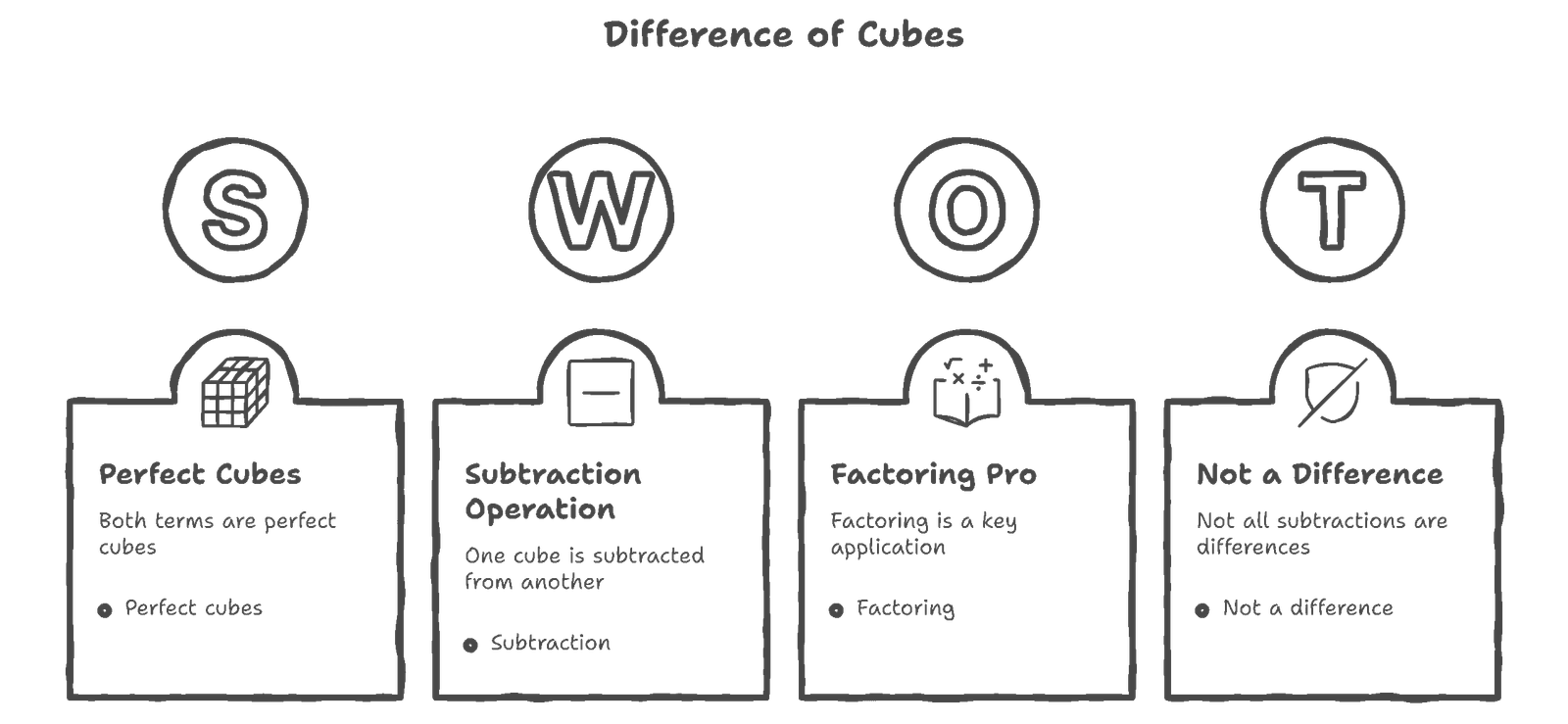
The Difference of Cubes occurs when one cube is subtracted from another.
In simple terms:
This means you are subtracting one cube (b³) from another cube (a³). Each cube represents a number or a variable raised to the third power.
For example:
- x³ – 27
- 8y³ – 1
- 64a³ – 125b³
Each of these is a difference of cubes because both terms are perfect cubes.
Formula for Difference of Cubes
The standard formula to factor the difference of cubes is:
This formula tells us that:
- The first bracket is a difference of the cube roots.
- The second bracket is a trinomial formed by squaring the first term, multiplying the two terms, and squaring the second term.
Let’s break it down:
| Term | Expression | Meaning |
|---|---|---|
| (a – b) | Difference of cube roots | Simplest binomial part |
| (a² + ab + b²) | Sum of squares and product | More complex trinomial part |
🔹 Step-by-Step Example 1: x³ – 27
Let’s factorize x³ – 27.
Here:
a = x
b = 3 (because 3³ = 27)
Now apply the formula:
✅ Factored Form:
x³ – 27 = (x – 3)(x² + 3x + 9)
That’s the simplest and most exact expression for the given cubic difference.
Step-by-Step Example 2: 8y³ – 1
Identify cube roots:
a = 2y because (2y)³ = 8y³
b = 1
Now apply the formula:
Simplify:
✅ Final Answer:
(2y – 1)(4y² + 2y + 1)
Learn one of the fastest factoring patterns by studying Difference of Squares Factorization , where expressions of the form a2 − b2 break into two binomials.
How to Identify a Difference of Cubes
You can easily recognize this pattern by following these steps:
- Check if both terms are perfect cubes.
Examples: 8 = 2³, 27 = 3³, 125 = 5³, etc. - Ensure it’s a subtraction (–) sign between them.
The difference of cubes must have a minus sign. - Write both cube roots clearly (like a and b).
- Apply the formula: (a – b)(a² + ab + b²).
- Simplify by multiplying or expanding only if needed.
🔹 Common Mistakes to Avoid
When factoring the difference of cubes, many learners make small but costly mistakes. Let’s go over them so you can avoid them easily:
-
Mixing up formulas for sum and difference of cubes.
Remember:
Difference → (a – b)(a² + ab + b²)
Sum → (a + b)(a² – ab + b²) -
Incorrect cube roots.
Always check if your cube roots are correct. For instance, cube root of 8x³ is 2x, not 4x or 3x. -
Forgetting to simplify coefficients.
If you have terms like 125a³ – 8b³, simplify it using (5a – 2b)(25a² + 10ab + 4b²).
🔹 Real-World Uses of Difference of Cubes
You might wonder, “Where is this formula used outside of math class?” Here are a few practical examples:
Engineering:
Engineers use cubic equations when analyzing volume differences, designing gear systems, and solving structural problems.
Computer Graphics:
Cubic relationships appear in 3D rendering equations, and simplifying them helps optimize algorithms.
Physics & Motion:
In motion and energy calculations, cubic terms often arise when working with momentum, energy, or volume displacement.
Data Science & Algorithms:
Difference of cubes can simplify complex polynomial functions, especially in data fitting or predictive models.
🔹 Visual Representation
If you were to visualize the difference of cubes geometrically:
- a³ represents a cube of side a.
- b³ represents a smaller cube of side b.
- The difference of cubes represents the remaining volume when the smaller cube is removed from the larger one.
This gives a physical meaning to the expression — not just numbers, but real 3D space difference.
🔹 Why Use a Difference of Cubes Calculator?
Manual calculation can be time-consuming, especially when expressions are large.
A Difference of Cubes Calculator automates this process instantly. It:
- Factors large cubic expressions in one click.
- Shows step-by-step breakdowns (useful for learning).
- Helps verify algebraic problems quickly.
Ideal for students, teachers, and professionals working with equations.
Enter x³ – 27 in your calculator → instantly get
✅ (x – 3)(x² + 3x + 9)
It saves time, ensures accuracy, and boosts learning efficiency.
🔹 Practice Problems
Try factoring the following using the formula:
- a³ – 8
- 27x³ – 1
- 125p³ – 64q³
- 343m³ – 27n³
- (a – 2)(a² + 2a + 4)
- (3x – 1)(9x² + 3x + 1)
- (5p – 4q)(25p² + 20pq + 16q²)
- (7m – 3n)(49m² + 21mn + 9n²)
🔹 Summary Table
| Concept | Formula | Example | Factored Result |
|---|---|---|---|
| Difference of Cubes | a³ – b³ = (a – b)(a² + ab + b²) | x³ – 27 | (x – 3)(x² + 3x + 9) |
| Check Terms | Both must be perfect cubes | 8y³ – 1 | (2y – 1)(4y² + 2y + 1) |
| Remember | Use “+” in trinomial always | — | — |
🔹 Conclusion
The Difference of Cubes formula is one of the most elegant tools in algebra. It transforms complicated cubic expressions into neat, manageable factors that can be used in solving equations or simplifying problems.
Whether you’re a student, a teacher, or a professional working with algebraic computations, mastering this formula will save time and increase accuracy.
Using an online Difference of Cubes Calculator enhances learning by giving instant solutions and explanations — perfect for practicing and verifying your work.
So next time you face something like x³ – 27, remember:
👉 It’s not complex — it’s just (x – 3)(x² + 3x + 9)!
Frequently Asked Questions
Difference: (a – b)(a² + ab + b²)
Sum: (a + b)(a² – ab + b²)
Remember: The sign in the first binomial always matches the original expression (Minus matches Minus).