
Difference of Squares Calculator
Note: This text is a placeholder title for the tool section. The detailed content follows below.
Introduction
One of the most elegant and widely used algebraic identities is the Difference of Squares. It’s a special type of factorization that appears frequently in mathematics, physics, and engineering calculations.
The difference of squares formula allows us to break down an expression involving two squared terms separated by a subtraction sign into a product of two simple binomials.
For example:
At first glance, it looks like magic — but it’s based on a logical and symmetrical algebraic pattern that makes simplifying or solving equations much easier.
In this article, we’ll dive deep into the Difference of Squares: what it is, how to identify it, the formula, step-by-step examples, common mistakes, and why your factorization calculator can solve it instantly.
What is a Difference of Squares?
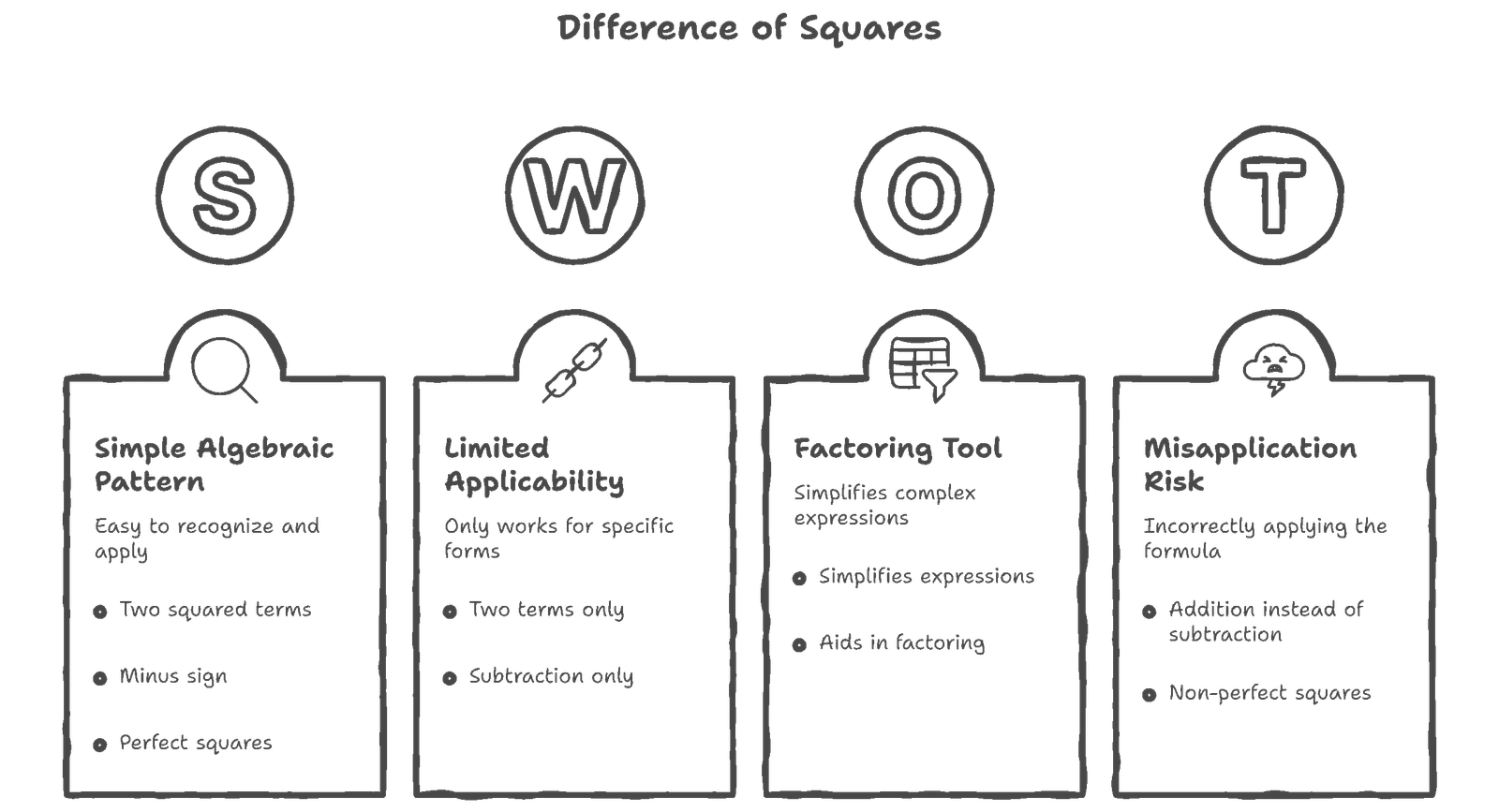
A Difference of Squares occurs when you have two squared terms separated by a minus sign (−).
The general form is:
a² – b²
where:
- a² is the square of the first term,
- b² is the square of the second term.
Both terms are perfect squares, and the operation between them is subtraction — not addition.
The Formula
The Difference of Squares Formula is:
This formula is derived directly from multiplying the two binomials:
(a + b)(a – b) = a² – ab + ab – b² = a² – b²
The middle terms (-ab and +ab) cancel each other out, leaving only a² – b².
That’s the beauty of this identity — it simplifies instantly and always works whenever both terms are perfect squares.
How to Identify a Difference of Squares
To recognize this type of expression, check for three simple conditions:
- Two terms only: There must be exactly two algebraic terms.
- Both are perfect squares: Each term should be something squared (e.g., x², 16y², 49, etc.).
- Separated by subtraction: The operation must be a minus (−) sign, not a plus.
If all three are true, you can apply the formula directly.
Examples of Difference of Squares
Let’s look at some basic and advanced examples to understand how the formula works.
Example 1: x² – 9
Here:
a² = x² → a = x
b² = 9 → b = 3
Apply the formula:
x² – 9 = (x + 3)(x – 3)
✅ Final Answer: (x + 3)(x – 3)
Example 2: 25x² – 49
Here:
a² = 25x² → a = 5x
b² = 49 → b = 7
Apply the formula:
25x² – 49 = (5x + 7)(5x – 7)
✅ Final Answer: (5x + 7)(5x – 7)
Example 3: 16y² – 81
Here:
a² = 16y² → a = 4y
b² = 81 → b = 9
16y² – 81 = (4y + 9)(4y – 9)
✅ Final Answer: (4y + 9)(4y – 9)
Example 4: m² – 64n²
Both are perfect squares:
m² = (m)²
64n² = (8n)²
Apply the formula:
m² – 64n² = (m + 8n)(m – 8n)
✅ Final Answer: (m + 8n)(m – 8n)
Example 5: 9a²b² – 4c²
Here:
9a²b² = (3ab)²
4c² = (2c)²
Apply:
9a²b² – 4c² = (3ab + 2c)(3ab – 2c)
✅ Final Answer: (3ab + 2c)(3ab – 2c)
Example 6: Nested Squares
Sometimes, the expression can contain more layers:
x⁴ – 16
Here:
x⁴ = (x²)²
16 = 4²
So:
x⁴ – 16 = (x² + 4)(x² – 4)
Now, notice that x² – 4 is again a difference of squares.
x² – 4 = (x + 2)(x – 2)
So the full factorization becomes:
x⁴ – 16 = (x² + 4)(x + 2)(x – 2)
✅ Final Answer: (x² + 4)(x + 2)(x – 2)
For expressions like a3 − b3, follow the step-by-step method in Difference of Cubes .
When You Can’t Apply It
It’s important to know when not to use the difference of squares formula.
You cannot apply it if:
- The operation is addition, not subtraction.
Example: x² + 9 → No, because it’s a sum of squares.
(Sum of squares cannot be factored using real numbers.) - One or both terms aren’t perfect squares.
Example: x² – 5 → No, because 5 isn’t a perfect square.
Step-by-Step Guide for Manual Calculation
- Identify perfect squares.
Look for expressions like x², 9y², 4, 25a², etc. - Check for subtraction.
Make sure it’s a difference (minus sign), not a sum. - Take square roots of both terms.
The roots will become the binomial parts. - Write the final factors.
(First root + Second root)(First root – Second root)
Using the Difference of Squares Calculator
Your Difference of Squares Factorization Calculator automates all the above steps instantly.
How It Works
- You input the expression (e.g., x² – 49).
- The tool checks if both terms are perfect squares.
- It applies the formula (a + b)(a – b).
- The result is shown instantly, along with each step of the breakdown.
Example
Input: 9a² – 16
Output: (3a + 4)(3a – 4)
The calculator makes it fast and foolproof, even for complex algebraic structures.
Common Mistakes Students Make
- Using it for addition:
Remember, it’s only for subtraction — a² – b², not a² + b². - Forgetting to simplify:
Sometimes one or both terms can be further broken down (like in x⁴ – 16). - Misidentifying perfect squares:
Always double-check that both terms are true squares before applying the formula. - Ignoring coefficients:
Coefficients must also form perfect squares — for example, 25x², not 20x².
Practical Uses of the Difference of Squares
The difference of squares identity is not just academic — it’s widely used in real-world scenarios, including:
- Engineering: Simplifying mechanical equations or resistance formulas.
- Physics: Reducing quadratic motion equations or energy formulas.
- Finance: Simplifying profit or loss functions.
- Programming: Used in algorithms and optimization problems for performance simplification.
For example, the formula helps in simplifying expressions like:
v² – u² = 2as
which is derived from the equations of motion — a direct real-life application of the difference of squares.
Advanced Example — Multiple Variables
49x²y² – 36z²
Here:
49x²y² = (7xy)²
36z² = (6z)²
Apply:
49x²y² – 36z² = (7xy + 6z)(7xy – 6z)
✅ Final Answer: (7xy + 6z)(7xy – 6z)
How to Verify the Result
Multiply the factors back to confirm:
(a + b)(a – b) = a² – b²
Example:
(x + 3)(x – 3) = x² – 9
If your expanded form matches the original expression, your factorization is correct.
Difference of Squares vs. Other Forms
| Type | Expression | Formula | Operation |
|---|---|---|---|
| Simple Trinomial (a = 1) | x² + bx + c | (x + m)(x + n) | Addition/Subtraction |
| General Trinomial (a ≠ 1) | ax² + bx + c | AC Method | Addition/Subtraction |
| Difference of Squares | a² – b² | (a + b)(a – b) | Subtraction Only |
This comparison helps you identify at a glance which formula applies to which type of expression.
Conclusion
The Difference of Squares is one of the simplest yet most powerful identities in algebra. It instantly converts complex-looking expressions into easy-to-manage factors using the formula:
a² – b² = (a + b)(a – b)
By mastering this, you can simplify quadratic equations, solve problems faster, and understand algebraic relationships deeply.
Whether you’re working on mathematical assignments or solving engineering equations, knowing how to apply the Difference of Squares — or using your factorization calculator to do it automatically — will save you time and enhance your problem-solving confidence.
Remember: every difference of squares hides a simple pattern. Once you spot it, the solution appears effortlessly.