
General Trinomial Factoring Calculator (a ≠ 1)
Instantly factor complex trinomials with step-by-step solutions.
Understanding General Trinomials
In algebra, factoring is one of the most critical skills you’ll learn. While many students start with simple quadratics where the leading coefficient is 1 (like x² + 5x + 6), real-world problems often involve more complex expressions.
A General Trinomial is a quadratic expression where the leading coefficient (the number in front of x²) is not 1. These expressions are generally harder to solve by mental math alone and require structured methods like factoring by grouping or the “AC Method”.
In this guide, we’ll break down what general trinomials are, how to factor them step-by-step, common pitfalls, and practical applications.
What Is a General Trinomial?
The standard form of a quadratic trinomial is:
Where:
- a, b, and c are constants (numbers)
- a ≠ 1 (This is what makes it a “general” or “complex” trinomial)
- x is the variable
Examples include:
- 6x² + 7x – 5
- 2x² + 9x + 4
- 3x² – 5x – 2
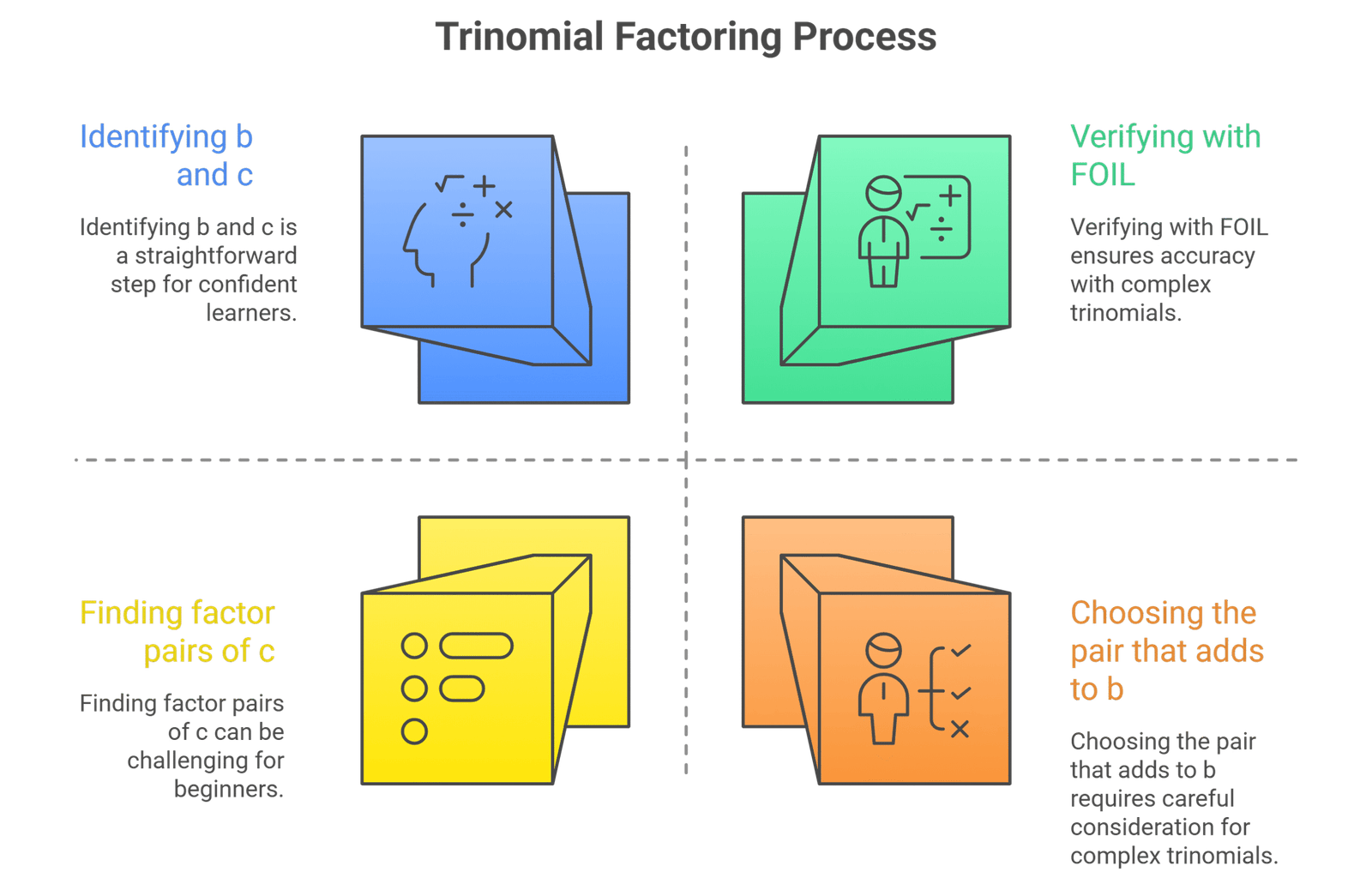
The Strategy: The “AC Method”
To factor general trinomials efficiently, we use a technique called the AC Method (also known as Splitting the Middle Term). Here is the process:
- Multiply a × c: Take the coefficient of x² (a) and the constant term (c), and multiply them.
- Find factors: Find two numbers that multiply to give this product (ac) and add up to give the middle coefficient (b).
- Rewrite the middle term: Split the middle term (bx) using these two numbers.
- Factor by grouping: Group the first two terms and the last two terms, then factor out the common elements.
Step-by-Step Example 1
Let’s factor the expression from our introduction: 6x² + 7x – 5
Step 1: Identify coefficients
a = 6, b = 7, c = -5
Step 2: Multiply a × c
6 × (-5) = -30
Step 3: Find factors
We need two numbers that multiply to -30 and add to +7.
The factors are +10 and -3.
(10) × (-3) = -30
(10) + (-3) = 7
Step 4: Rewrite and Group
Rewrite 7x as 10x – 3x:
6x² + 10x – 3x – 5
Group terms:
(6x² + 10x) – (3x + 5)
Factor out GCF from each group:
2x(3x + 5) – 1(3x + 5)
Step 5: Final Factorization
Notice that (3x + 5) is common to both parts.
(3x + 5)(2x – 1)
✅ Final Answer: (3x + 5)(2x – 1)
Step-by-Step Example 2: Checking for Common Factors
Always check for a Greatest Common Factor (GCF) before starting the AC Method. It simplifies the numbers significantly.
Expression: 4x² + 18x + 8
Notice that all numbers are divisible by 2.
2(2x² + 9x + 4)
Now factor the inner trinomial (2x² + 9x + 4):
a × c = 2 × 4 = 8
Factors adding to 9 are 8 and 1.
Rewrite:
2(2x² + 8x + 1x + 4)
2[2x(x + 4) + 1(x + 4)]
2(x + 4)(2x + 1)
✅ Final Answer: 2(x + 4)(2x + 1)
Before factoring complex expressions, it often helps to simplify numbers using Prime Factorization .
Common Mistakes to Avoid
- Forgetting the GCF: Skipping the first step of factoring out the greatest common factor makes the problem harder than it needs to be.
- Sign Errors: When c is negative, one factor must be positive and one negative. Pay close attention to which is which.
- Stopping Early: Always check if your factors can be factored further (e.g., Difference of Squares).
Real-World Applications
General trinomials appear frequently in advanced fields:
| Field | Application |
|---|---|
| Projectile Motion | calculating the time an object is in the air (h = -16t² + vt + s). |
| Economics | Modeling profit curves where coefficients represent variable costs and demand elasticities. |
| Engineering | Analyzing structural integrity and signal processing using quadratic optimization functions. |
Using the General Trinomial Factorization Calculator
Struggling to factor trinomials like 6x² + 7x – 5? Our general trinomial calculator handles the tough ones in seconds.
Just enter your expression, and get instant results with complete step-by-step solutions. Perfect for homework, test prep, or quick verification!
How It Helps:
- Speed: Solves complex ‘a ≠ 1’ problems instantly.
- Learning: Reveals the “split” in the middle term so you can learn the method.
- Accuracy: Eliminates sign errors and arithmetic mistakes.
Practice Problems
Try these on your own:
- 3x² + 10x + 3
- 2x² – 5x – 3
- 4x² – 9 (Hint: Difference of Squares is a type of trinomial where b=0!)
- (3x + 1)(x + 3)
- (2x + 1)(x – 3)
- (2x + 3)(2x – 3)
Conclusion
Mastering general trinomials unlocks the door to solving more complex algebraic equations. While the numbers may look intimidating at first, the “AC Method” provides a reliable roadmap to the solution every time.
Remember to always check for a GCF first, watch your signs, and verify your answer by expanding the binomials back out. And for those truly tough problems, use the calculator above to check your work and learn from the steps!