
How to Factor Polynomials: Complete Step by Step Guide
Factoring polynomials means breaking them into simpler pieces that multiply together. It’s like writing 12 as 3 × 4, except with algebra.
I’ll show you every factoring method for high school and college. You’ll learn which method to use for any polynomial.
The secret is pattern recognition. Once you identify your polynomial type, the method becomes obvious.
Table of Contents
Why Factor?
Solving equations:
x² + 5x + 6 = 0
factors to (x + 2)(x + 3) = 0.
Set each to zero:
x = -2 or
x = -3.
Simplifying fractions:
(x² – 4)/(x + 2)
factors top to (x – 2)(x + 2)
, cancel (x + 2),
get x – 2.
Graphing:
y = (x + 2)(x – 3)
crosses x axis at -2 and 3
(visible from factors).
Real world:
Physics, engineering, finance all use factored polynomials.
RULE #1: Always Check GCF First
Before any method, check for greatest common factor. Factor it out first.
Example 1:
6x² + 9x
GCF = 3x
3x(2x + 3)
Example 2:
4x³ + 8x² + 4x
GCF = 4x
4x(x² + 2x + 1)
4x(x + 1)²
Example 3:
x³ – x
GCF = x
x(x² – 1)
x(x – 1)(x + 1)
Missing GCF makes everything harder. CHECK IT FIRST.
Decision Flowchart
Follow this 5-step process, it handles 99% of algebra problems.
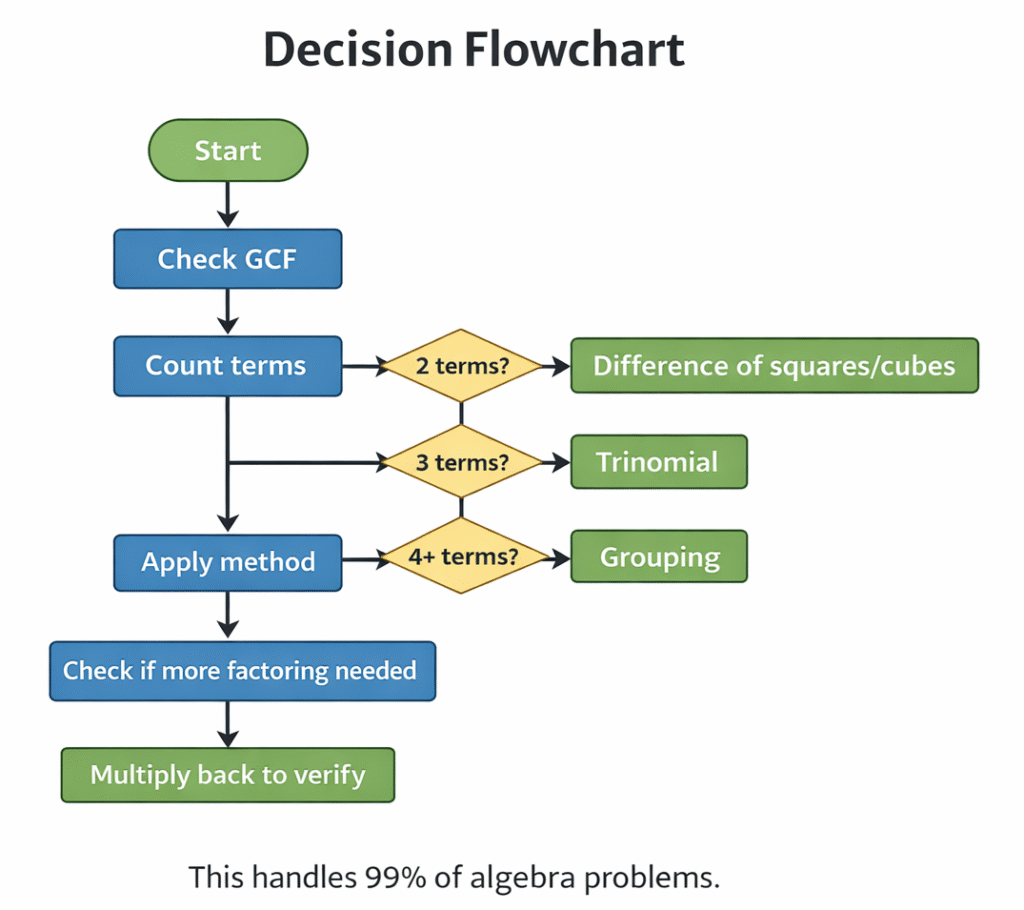
Step 1:
GCF check
Step 2:
Count terms:
Step 3:
Apply method
Step 4:
Check if more factoring needed
Step 5:
Multiply back to verify
Trinomials (3 Terms)
When a = 1 (Simple)
For x² + bx + c, find two numbers that multiply to c and add to b.
x² + 7x + 12
Need: multiply to 12, add to 7
Try: 3 and 4 (3×4=12, 3+4=7)
Answer: (x + 3)(x + 4)
x² – 5x + 6
Need: multiply to +6, add to -5
Both negative: -2 and -3
Answer: (x – 2)(x – 3)
x² + x – 6
Need: multiply to -6, add to +1
One positive
one negative: 3 and -2
Answer: (x + 3)(x – 2)
When a ≠ 1 (AC Method)
For 6x² + 7x – 5:
Step 1: Multiply a × c = 6 × -5 = -30
Step 2: Find numbers multiply to -30, add to 7: (10, -3)
Step 3: Rewrite: 6x² + 10x – 3x – 5
Step 4: Group: 2x(3x + 5) – 1(3x + 5)
Step 5: Factor out: (3x + 5)(2x – 1)
Check: (3x + 5)(2x – 1) = 6x² + 7x – 5
Difference of Squares
Formula: a² – b² = (a + b)(a – b)
x² – 9 Both perfect squares,
minus sign (x + 3)(x – 3)
4x² – 25 (2x)² – 5²
(2x + 5)(2x – 5)
x⁴ – 16 (x²)² – 4² (x² + 4)(x² – 4)
Keep factoring: (x² + 4)(x + 2)(x – 2)
Important: Sum of squares (x² + 9) doesn’t factor over real numbers.
Sum/Difference of Cubes
Sum: a³ + b³ = (a + b)(a² – ab + b²)
Difference: a³ – b³ = (a – b)(a² + ab + b²)
x³ + 8 = x³ + 2³
= (x + 2)(x² – 2x + 4)
27x³ – 64 = (3x)³ – 4³
= (3x – 4)(9x² + 12x + 16)
Memory:
Sum = (sum)(minus middle)
Difference = (difference)(plus middle)
Trinomials from cube formulas rarely factor further.
Perfect Square Trinomials
Pattern: a² + 2ab + b² = (a + b)²
Pattern: a² – 2ab + b² = (a – b)²
x² + 6x + 9 First/last are squares: x² and 9 (3²)
Middle = 2(x)(3) = 6x ✓
Answer: (x + 3)²
4x² – 12x + 9 Squares: (2x)² and 3²
Middle: 2(2x)(3) = 12x
Answer: (2x – 3)²
Quick check: Is middle term exactly 2ab?
Factoring by Grouping (4+ Terms)
For 4-term polynomials, group first two and last two.
x³ + 3x² + 2x + 6
Group: (x³ + 3x²) + (2x + 6)
Factor each: x²(x + 3) + 2(x + 3)
Common factor: (x + 3)(x² + 2)
6x³ – 9x² + 4x – 6
Group: (6x³ – 9x²) + (4x – 6)
Factor: 3x²(2x – 3) + 2(2x – 3)
Result: (2x – 3)(3x² + 2)
Grouping works when common binomial appears.
Quartic Polynomials (x⁴)
x⁴ – 5x² + 4
Substitute u = x²:
u² – 5u + 4
Factor trinomial: (u – 4)(u – 1)
Substitute back: (x² – 4)(x² – 1)
Factor further: (x – 2)(x + 2)(x – 1)(x + 1)
This substitution method works for even powers.
Prime Factorization
2x² – 50
GCF = 2: 2(x² – 25)
Difference of squares: 2(x – 5)(x + 5)
Prime factorization of numbers helps find GCF.
12 = 2 × 2 × 3 18
=2 × 3 × 3
GCF = 2 × 3
=6
Apply same idea to polynomials.
Common Mistakes
Forgetting to check GCF first :
Wrong: Factor x² + 4x + 4 directly
Right: Check GCF (none), then factor to (x + 2)²
Forgetting to factor completely:
x⁴ – 16 = (x² – 4)(x² + 4) INCOMPLETE
Complete: (x – 2)(x + 2)(x² + 4)
Sign errors:
x² – 5x + 6 needs BOTH negative: (x – 2)(x – 3) Not (x + 2)(x + 3)
Not multiplying back to check:
Always verify by expanding your factors.
Practice Problems
Try these yourself first, then check answers below.
| 🟢Easy | 🟡 Medium | 🔴 Hard |
| x² + 8x + 15 | 6x² + 11x + 3 | 2x⁴ − 32 |
| x² − 9 | x³ + 27 | x³−4x²−9x+36 |
| 3x² + 6x | x³+3x²+2x+6 | 4x²−20x+25 |
Answers:
- (x + 3)(x + 5)
- (x − 3)(x + 3)
- 3x(x + 2)
- (3x + 1)(2x + 3)
- (x + 3)(x² − 3x + 9)
- (x + 3)(x² + 2)
- 2(x−2)(x+2)(x²+4)
- (x−4)(x−3)(x+3)
- (2x − 5)²
Real World Applications
Physics:
Find when a projectile hits the ground using factored form.
h = −16t² + 64t
= −16t(t − 4)
Hits ground: t = 4s
Business
Profit function – find break-even production units.
P = −2x²+40x−50
= −2(x−1)(x−19)
Break-even: x = 1, 19
Geometry
Area expression reveals rectangle dimensions instantly.
Area = x²+10x+21
= (x+3)(x+7)
Sides: (x+3), (x+7)
When Polynomials Don’t Factor
Some polynomials are prime (can’t factor).
x² + 1 – Sum of squares (prime over real numbers)
x² + x + 1 – Discriminant negative (prime)
2x + 3 – Linear expressions don’t factor
If you can’t find factors after trying methods, it might be prime.
Quick Reference Chart
| Type | Example | Method |
| 2 terms, squares | x² – 9 | Difference of squares |
| 2 terms, cubes | x³ + 8 | Sum/difference cubes |
| 3 terms, a=1 | x² + 5x + 6 | Simple trinomial |
| 3 terms, a≠1 | 2x² + 7x + 3 | AC method |
| 3 terms, perfect square | x² + 6x + 9 | Perfect square |
| 4 terms | x³ + 2x² + 3x + 6 | Grouping |
| Any | 6x² + 9x | Check GCF FIRST |
Checking Your Work
Always multiply factors back:
Example:
(x + 2)(x + 3)
= x² + 3x + 2x + 6
= x² + 5x + 6 ✓
If it doesn’t match, you made a mistake.
Study Tips
Summary
Factoring polynomials follows a systematic approach:
Step 1: Look for GCF Step 2: Identify polynomial type (count terms, look for patterns) Step 3: Apply appropriate method Step 4: Check if factors need more factoring Step 5: Multiply back to verify.
Master these methods:
- GCF factoring (always first)
- Simple trinomials (most common)
- AC method (complex trinomials)
- Difference of squares (memorize formula)
- Sum/difference of cubes (memorize formulas)
- Grouping (4+ terms)
- Perfect squares (recognize pattern)
With practice, pattern recognition becomes automatic. You’ll see a polynomial and immediately know which method to use.