
Perfect Square Trinomial Calculator
Instantly identify and factor perfect square trinomials with step-by-step solutions
The Perfect Square Trinomial Calculator quickly identifies and factors expressions that follow the pattern (a ± b)². It checks whether the first and last terms are perfect squares and verifies the middle term before generating step by step solutions. This tool is accurate, easy to use, and helpful for algebra practice, homework verification, and exam preparation.
What is a Perfect Square Trinomial?
A perfect square trinomial is a special type of math expression with three terms that comes from squaring a binomial. Think of it like this: when you multiply (a + b) by itself, you get a² + 2ab + b². That result is a perfect square trinomial!
There are two basic patterns:
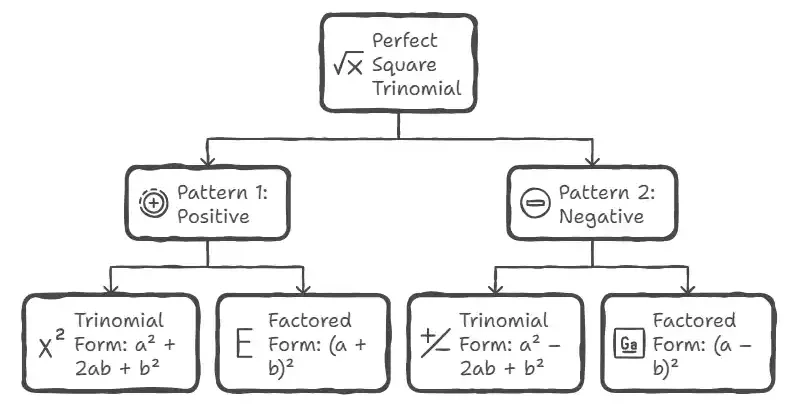
| Pattern Type | Trinomial Form | Factored Form |
|---|---|---|
| Pattern 1: Positive | a² + 2ab + b² | (a + b)² |
| Pattern 2: Negative | a² – 2ab + b² | (a – b)² |
What makes perfect square trinomials special? They always factor into two identical binomials. For example,
x² + 6x + 9 becomes (x + 3)², not (x + 3)(x + 3) written separately.
- First term must be a perfect square (like x², 4x², 9y²)
- Last term must be a perfect square (like 4, 9, 25, 49)
- Middle term = ±2 × √(first term) × √(last term)
Our perfect square trinomial calculator automatically checks all three rules to verify if your expression matches this pattern.
How to Identify a Perfect Square Trinomial (3-Step Method)
Want to quickly check if a trinomial is a perfect square? Follow these three simple steps:
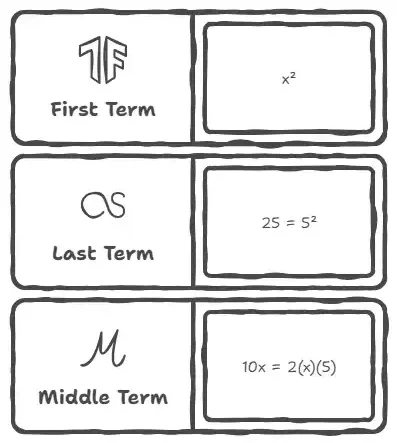
Look at the first term (the one with x²). Can you find a number or expression that, when multiplied by itself, gives you this term? Do the same for the last term (the number without x).
Example: In 4x² – 12x + 9
• First term: 4x² = (2x)² ✓
• Last term: 9 = (3)² ✓
Take the square root of both the first and last terms. These will be the two parts of your factored form.
Example: √(4x²) = 2x and √9 = 3
Multiply your two square roots together, then multiply by 2. Does this match your middle term (ignoring the sign for now)?
Example: 2 × 2x × 3 = 12x
Our middle term is -12x, so yes! ✓
- First term is a perfect square?
- Last term is a perfect square?
- Middle term = 2 × (root₁) × (root₂)?
→ If all YES = Perfect Square Trinomial!
Mini Examples – Try These:
-
x² + 8x + 16 → Perfect Square!
First: x² ✓, Last: 16 = 4² ✓, Middle: 2(x)(4) = 8x ✓ -
4x² – 20x + 25 → Perfect Square!
First: 4x² = (2x)² ✓, Last: 25 = 5² ✓, Middle: 2(2x)(5) = 20x ✓
-
x² + 6x + 8 → Not a Perfect Square
First: x² ✓, Last: 8 (not a perfect square) ✗
The Discriminant Method (How Our Calculator Works)
There’s a faster way to check: use the discriminant formula Δ = b² – 4ac. If the result equals zero, you have a
perfect square trinomial. This is exactly what our calculator uses to give you instant results!
How to Use the Perfect Square Trinomial Calculator
Using our calculator is super easy! Here’s how:
Type in your full trinomial expression. (e.g., 4x^2 - 12x + 9)
• Use the minus sign (-) for negative coefficients
• You can enter whole numbers, fractions, or decimals
• Use
^ for exponents (e.g. x^2)Hit the calculate button and watch the magic happen! The calculator will check the discriminant and show the factored form.
You’ll see if it is a Perfect Square, the Discriminant checks (background logic), and the final Factored Form.
If you are new to factoring, start with Simple Trinomial Factorization to learn how to factor expressions where the leading coefficient is 1.
Perfect Square Trinomial Examples (Solved Step-by-Step)
Let’s work through some examples together so you can see exactly how to factor perfect square trinomials.
Example 1: Factor x² + 10x + 25
First term: x² = (x)²
Last term: 25 = (5)²
Calculate 2 × x × 5 = 10x
Our middle term is +10x ✓ Perfect match!
Since our middle term is positive, we use the formula (a + b)²:
x² + 10x + 25 = (x + 5)²
Example 2: Factor 4x² – 12x + 9
First term: 4x² = (2x)² — Don’t forget to take √4 = 2!
Last term: 9 = (3)²
Calculate 2 × 2x × 3 = 12x
Our middle term is -12x (negative) ✓
Since our middle term is negative, we use (a – b)²:
4x² – 12x + 9 = (2x – 3)²
Example 3: Factor 9y² + 24y + 16
Notice this example uses the variable y instead of x. The process is exactly the same!
Step 1: Identify the perfect squaresFirst term: 9y² = (3y)²
Last term: 16 = (4)²
Calculate 2 × 3y × 4 = 24y
Middle term: +24y ✓
9y² + 24y + 16 = (3y + 4)²
Example 4: Why x² + 6x + 8 is NOT a Perfect Square
First term: x² = (x)² ✓ This part works
Last term: 8 = ?
The problem is here! 8 is not a perfect square. √8 = 2.83…, which isn’t a whole number.
Conclusion:This is a regular trinomial, not a perfect square. You would factor it differently:
(x + 2)(x + 4)
Example 5: When to Factor Out GCF First
Problem: Factor 2x² + 8x + 8
At first glance, this doesn’t look like a perfect square. But wait! Notice that all three terms are divisible by 2.
Step 1: Factor out the Greatest Common Factor (GCF)2x² + 8x + 8 = 2(x² + 4x + 4)
Step 2: Now check if what’s left is a perfect squareLooking at x² + 4x + 4:
• First term: x² = (x)² ✓
• Last term: 4 = (2)² ✓
• Middle term: 2 × x × 2 = 4x ✓
2(x + 2)²
Perfect Square Formulas (Quick Reference)
| Pattern Type | Trinomial Form | Factored Form |
|---|---|---|
| Positive Middle Term | a² + 2ab + b² | (a + b)² |
| Negative Middle Term | a² – 2ab + b² | (a – b)² |
If middle term is POSITIVE → use (a + b)²
If middle term is NEGATIVE → use (a – b)²
The sign in the middle of your trinomial determines the sign in your factored form. It’s that simple!
5 Common Mistakes When Factoring Perfect Square Trinomials
✗ Wrong: Trying to force x² + 5x + 6 into perfect square form
✓ Right: Always check all three conditions first!
✗ Wrong: x² – 6x + 9 = (x + 3)²
✓ Right: x² – 6x + 9 = (x – 3)²
✗ Wrong: 4x² + 12x + 9 = (4x + 3)²
✓ Right: 4x² + 12x + 9 = (2x + 3)²
Rule: Take the square root of the entire coefficient.✗ Wrong: Thinking x² + 4x + 4 needs a middle term of 2x
✓ Right: Middle term must be 2ab = 2(x)(2) = 4x
✗ Wrong: Trying to factor 3x² + 18x + 27 directly
✓ Right: Factor out GCF first: 3(x² + 6x + 9) = 3(x + 3)²
Practice Problems (Test Your Skills)
Ready to test what you’ve learned? Try these practice problems! Start with Level 1 and work your way up.
Level 1: Basic (a = 1)
- 1. x² + 8x + 16
- 2. x² – 10x + 25
- 3. x² + 14x + 49
Level 2: Intermediate (a ≠ 1)
- 4. 4x² + 12x + 9
- 5. 9y² – 30y + 25
- 6. 16x² + 24x + 9
Level 3: Advanced
- 7. 25x² – 20x + 4
- 8. 2x² + 8x + 8
Level 4: Trick Questions
- 9. x² + 6x + 8
- 10. 4x² + 10x + 9
1. Try solving each problem on your own
2. Click “Solve” to use the calculator
3. If you got it wrong, study the steps!
Where Perfect Square Trinomials Are Used
Converting x² + 6x = 7 into vertex form…
Calculating side lengths from area…
Motion equations and trajectories…
Structural design equations…
Animation and curve modeling rely on quadratic functions.
Frequently Asked Questions
A: Use the discriminant formula: Δ = b² – 4ac. If it equals zero, you have a perfect square!
A: Yes! The pattern works with any real numbers.
A: No problem! Just use the square root of that coefficient (e.g., √4x² = 2x).
Other Factoring Techniques
Not all trinomials are perfect squares.
- General Trinomial (a=1): Find numbers adding to b and multiplying to c.
- AC Method (a≠1): Multiply a×c and group.
- Difference of Squares: a² – b².
Master Perfect Square Trinomials Today
Perfect square trinomials follow simple, predictable patterns. Use this calculator as your training wheels!