
Prime Factorization Calculator
Instantly break down any number into its prime factors with step-by-step solutions
The Prime Factorization Calculator breaks whole numbers into their prime components in just seconds. When you enter a number like 60, it returns the prime factors such as 2 × 2 × 3 × 5 along with clear step-by-step reasoning. This tool is ideal for students and anyone checking factorization work without manual calculation.
What is Prime Factorization?
Prime factorization is the process of breaking down a composite number into a product of prime numbers. Think of it like this: every number is built from smaller building blocks called prime numbers, just like molecules are made from atoms!
The general concept:
Composite Number = Prime₁ × Prime₂ × Prime₃…
Here:
- Prime numbers are numbers divisible only by 1 and themselves (2, 3, 5, 7, 11, 13…)
- Composite numbers are numbers with more than two factors (4, 6, 8, 9, 10…)
- Prime factorization is the unique way to express any composite number as a product of primes
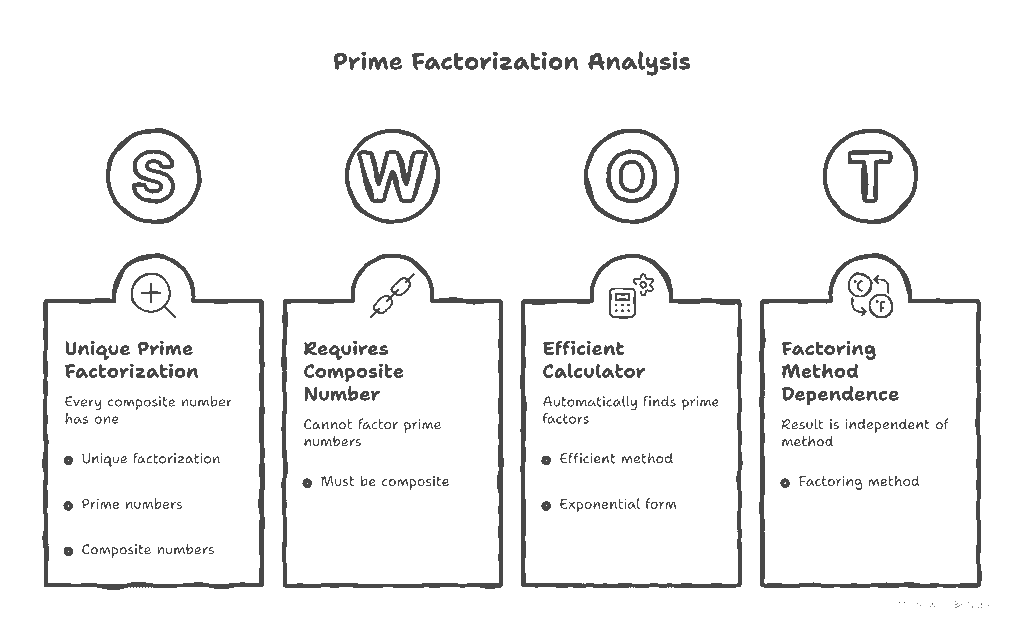
What makes prime factorization special? Every composite number has exactly ONE unique prime factorization. For example, 60 can ONLY be expressed as 2 × 2 × 3 × 5.
Quick Recognition Rules
- Number must be composite (not prime itself)
- Final result contains only prime numbers
- Same result regardless of factoring method used
- Can be written in exponential form (e.g., 2² × 3 × 5)
Our prime factorization calculator automatically finds all prime factors using the most efficient method.
Also, learn the standard method for factoring trinomials in the form ax² + bx + c.
How to Find Prime Factors – 3-Step Method
Want to quickly find the prime factors of any number? Follow these three simple steps:
Step 1
Start with the smallest prime (2)
Check if your number is divisible by 2. If yes, divide and repeat. If no, move to the next prime (3).
Example: For 60
- 60 ÷ 2 = 30 ✓
- 30 ÷ 2 = 15 ✓
Step 2
Move to the next prime when stuck
When the current prime no longer divides evenly, try the next prime number (3, 5, 7, 11…).
Example: 15 is odd, so try 3
- 15 ÷ 3 = 5 ✓
Step 3
Stop when you reach a prime
When your quotient becomes a prime number, you’re done! List all the divisors used.
Example: 5 is already prime Prime factors: 2, 2, 3, 5 Answer: 60 = 2 × 2 × 3 × 5
Quick Test Checklist
Mini Examples – Try These:
12 → Prime factors found! 12 ÷ 2 = 6, 6 ÷ 2 = 3 Primes: 2, 2, 3 ✓ Answer: 12 = 2² × 3
90 → Multiple prime factors! 90 ÷ 2 = 45, 45 ÷ 3 = 15, 15 ÷ 3 = 5 Primes: 2, 3, 3, 5 ✓ Answer: 90 = 2 × 3² × 5
17 → Already prime! 17 has no divisors except 1 and 17 Result: Cannot be factored further
Factor expressions like a³ + b³ quickly using the sum of cubes identity.
How Our Calculator WorksThere’s a systematic way to find prime factors: the division method. You repeatedly divide by prime numbers starting from 2, then 3, 5, 7, and so on, until you reach 1.
This is exactly what our calculator uses to give you instant, accurate results with zero guesswork!
How to Use the Prime Factorization Calculator
Using our calculator is super easy! Here’s how:
Step 1
Enter Your Number
Type in any whole number you want to factor (e.g., 60, 144, 1000)
Input Tips:
- Enter positive whole numbers only
- Works with numbers up to millions
- Cannot factor prime numbers (they’re already in simplest form)
Step 2
Click “Factorize Now”
Hit the calculate button and watch the magic happen! The calculator will systematically divide by primes and show the complete breakdown.
Step 3
View Your Results
You’ll see:
- Complete list of prime factors
- Exponential form (e.g., 2³ × 3 × 5)
- Step-by-step division process
- Verification by multiplication
Prime Factorization Examples (Solved Step-by-Step)
Let’s work through some examples together so you can see exactly how to find prime factors.
Example 1: Prime Factorization of 60
Step 1: Start dividing by 2 60 ÷ 2 = 30
Step 2: Continue with 2 30 ÷ 2 = 15
Step 3: Try 3 (15 is odd) 15 ÷ 3 = 5
Step 4: 5 is prime, stop here
Prime factors: 2, 2, 3, 5 Standard form: 60 = 2 × 2 × 3 × 5 Exponential form: 60 = 2² × 3 × 5
Verification: 2 × 2 × 3 × 5 = 4 × 3 × 5 = 60 ✓
Example 2: Prime Factorization of 72
Step 1: Divide by 2 repeatedly 72 ÷ 2 = 36 36 ÷ 2 = 18 18 ÷ 2 = 9
Step 2: Switch to 3 (9 is odd) 9 ÷ 3 = 3 3 ÷ 3 = 1
Prime factors: 2, 2, 2, 3, 3 Exponential form: 72 = 2³ × 3²
Why exponential form matters: Writing 2³ instead of 2 × 2 × 2 saves space and makes patterns clearer!
Example 3: Prime Factorization of 90
Step 1: Start with 2 90 ÷ 2 = 45
Step 2: Move to 3 45 ÷ 3 = 15 15 ÷ 3 = 5
Step 3: 5 is prime
Prime factors: 2, 3, 3, 5 Standard form: 90 = 2 × 3 × 3 × 5 Exponential form: 90 = 2 × 3² × 5
Example 4: Prime Factorization of 100
Notice this number has repeated factors!
Step 1: Divide by 2 twice 100 ÷ 2 = 50 50 ÷ 2 = 25
Step 2: Try 3 (doesn’t work) 25 is not divisible by 3
Step 3: Try 5 25 ÷ 5 = 5 5 ÷ 5 = 1
Prime factors: 2, 2, 5, 5 Exponential form: 100 = 2² × 5²
Key insight: When you see a number ending in 00, 25, 50, or 75, it’s likely divisible by 5!
Example 5: Why 17 Cannot Be Factored
Step 1: Check divisibility 17 ÷ 2 = 8.5 (not whole) 17 ÷ 3 = 5.67 (not whole) 17 ÷ 5 = 3.4 (not whole)
The problem: No prime number divides 17 evenly except 17 itself.
Conclusion: 17 is a prime number. Its only factors are 1 and 17.
Prime Factorization Methods (Quick Reference)
| Method | Best For | Visual? | Speed |
| Division Method | Any number | No | Fast |
| Factor Tree | Smaller numbers | Yes | Medium |
| Calculator | Large numbers | No | Instant |
Method Comparison
✓ Division Method → Systematic, never miss factors, works for any size number
✓ Factor Tree → Visual learners, good for understanding, fun for small numbers
✓ Calculator → Verification, homework checking, numbers over 1000
5 Common Mistakes When Finding Prime Factors
Mistake #1: Forgetting 2 is the Only Even Prime
✗ Wrong: Thinking 4, 6, 8 are prime numbers
✓ Right: 2 is the ONLY even prime. All other even numbers are composite.
Mistake #2: Stopping Too Early
✗ Wrong: Factoring 60 as 6 × 10 and calling it done
✓ Right: Keep factoring until only primes remain: 2 × 2 × 3 × 5
Mistake #3: Skipping Verification
✗ Wrong: Not multiplying factors back to check
✓ Right: Always verify: 2 × 2 × 3 × 5 = 60 ✓
Mistake #4: Wrong Exponential Notation
✗ Wrong: Writing 60 = 2³ × 3 × 5 (2 only appears twice, not three times!)
✓ Right: Count carefully: 60 = 2² × 3 × 5
Mistake #5: Trying to Factor 1
✗ Wrong: Looking for prime factors of 1
✓ Right: 1 is neither prime nor composite. It has no prime factorization.
Practice Problems (Test Your Skills)
Ready to test what you’ve learned? Try these practice problems! Start with Level 1 and work your way up.
Level 1: Small Numbers
- 24
- 36
- 45
Level 2: Medium Numbers
- 84
- 126
- 144
Level 3: Larger Numbers
- 180
- 225
Level 4: Challenge
- 1000
- Is 97 prime or composite?
How to Check Your Answers:
- Try solving each problem on your own
- Click “Solve” to use the calculator
- Multiply your factors back to verify!
Where Prime Factorization is Used
Finding GCF (Greatest Common Factor)
Prime factorization makes finding GCF simple. Factor both numbers, then multiply common primes using lowest powers.
Calculating LCM (Least Common Multiple)
For LCM, use the highest power of each prime that appears in either factorization.
Simplifying Fractions
Factor numerator and denominator, then cancel common prime factors.
Cryptography & Online Security
RSA encryption uses massive prime numbers (300+ digits) to keep your passwords and credit cards safe.
Engineering & Design
Gear ratios, signal processing, and system optimization all rely on prime factorization.
Frequently Asked Questions
Other Factoring Techniques
Prime factorization is just one type of factoring. Here are related concepts:
Greatest Common Factor (GCF): Find common primes, use lowest powers
Least Common Multiple (LCM): Find all primes, use highest powers
Perfect Squares: Numbers where all prime exponents are even (e.g., 36 = 2² × 3²)
Factor Trees: Visual method for finding prime factors
Divisibility Rules: Quick checks for 2, 3, 5, 9, 10 to speed up factoring
Master Prime Factorization Today
Prime factorization reveals the building blocks of every composite number. Use this calculator to check your work, verify homework, or simply understand how numbers are constructed!
The process is always:
Start with smallest prime (2)
Divide repeatedly by each prime
Move to next prime when stuck
Stop when quotient is prime
Write in exponential form
Practice with 5-10 numbers daily, and you’ll recognize common prime factorizations instantly!
Understanding prime factors helps you master GCF, LCM, fraction simplification, and even appreciate how modern encryption protects your digital life.