
Sum of Cubes Calculator
Simplify algebraic expressions with perfect cubes instantly.
Sum of Cubes Calculator
The Sum of Cubes Calculator quickly factors expressions in the form a³ + b³ using the standard identity (a + b)(a² − ab + b²). It shows each step clearly so you understand how the formula is applied. This tool provides accurate results instantly and is ideal for algebra practice, homework checking, and exam preparation.
Just like the Difference of Cubes, the sum of cubes gives us a quick way to factor complex cubic expressions into smaller, more manageable parts. This technique is essential in algebra, calculus, engineering, and even computer algorithms that rely on polynomial simplifications.
In this article, we’ll explore what the Sum of Cubes means, its formula, examples, common mistakes, and real-world applications — along with why a Sum of Cubes Calculator can make your work easier and faster.
What Is the Sum of Cubes?
The Sum of Cubes refers to any algebraic expression in which one cube is added to another cube.
In mathematical form:
a³ + b³
Here, both a³ and b³ are perfect cubes — meaning they are obtained by raising a number or variable to the power of 3.
A few common examples include:
- x³ + 8
- 27y³ + 1
- 64a³ + 125b³
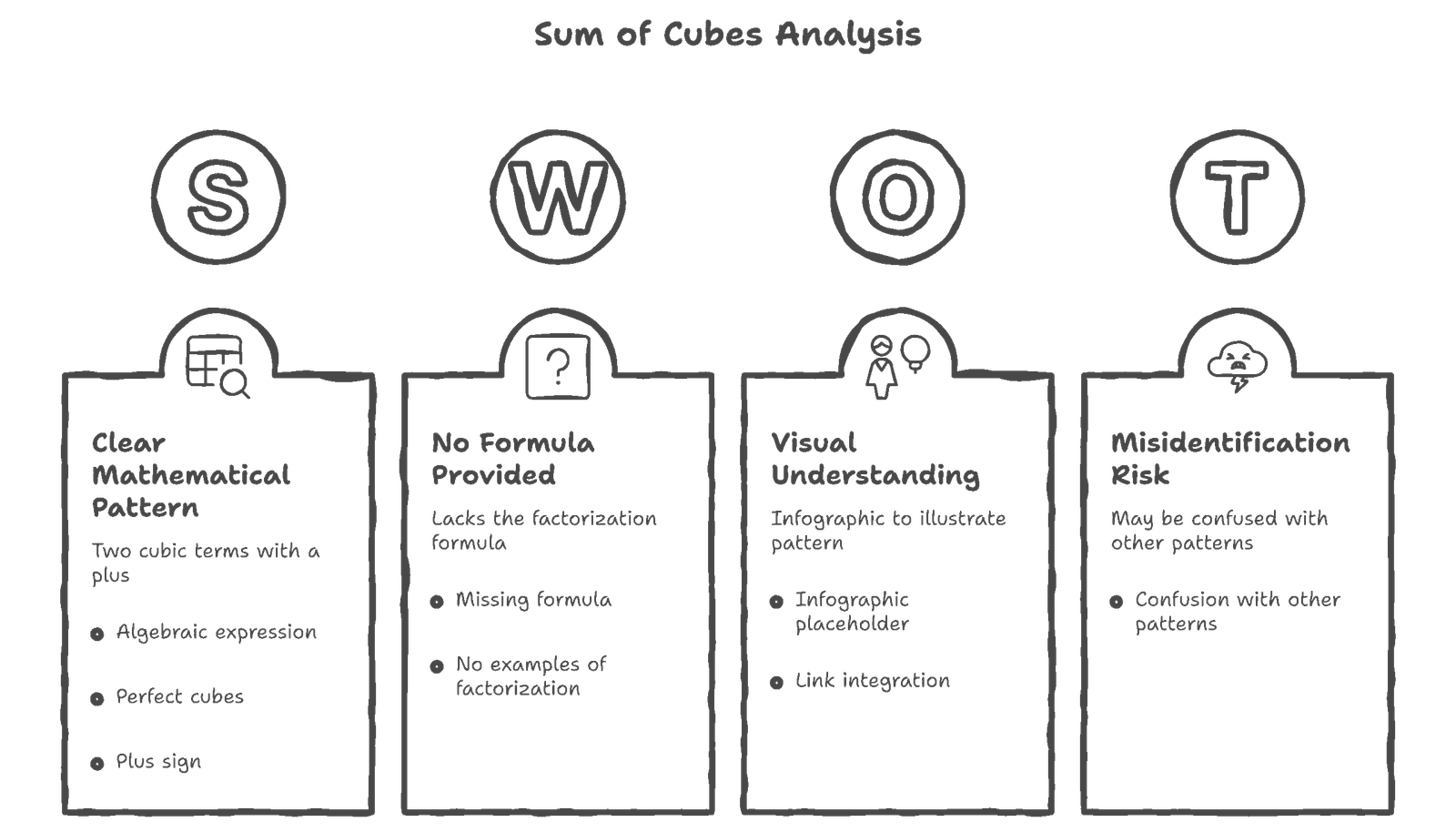
All of these expressions have the same pattern: two cubic terms joined with a plus (+) sign.
🔹 Formula for Sum of Cubes
The standard factoring formula for the sum of cubes is:
This looks quite similar to the Difference of Cubes formula, except for one important difference — the signs inside the factors.
| Type | Formula |
|---|---|
| Difference of Cubes | a³ – b³ = (a – b)(a² + ab + b²) |
| Sum of Cubes | a³ + b³ = (a + b)(a² – ab + b²) |
Tip to Remember:
“Same sign outside, opposite sign inside.”
When you factor a³ + b³, the first sign (+) stays the same, but the middle term in the trinomial flips to negative (–).
Step-by-Step Example 1: x³ + 8
Let’s factorize x³ + 8 step by step.
We can rewrite 8 as 2³, since 2 × 2 × 2 = 8.
So: x³ + 8 = x³ + 2³
Here: a = x, b = 2
Now apply the formula:
a³ + b³ = (a + b)(a² – ab + b²)
Substitute the values:
x³ + 8 = (x + 2)(x² – 2x + 4)
✅ Factored Form:
x³ + 8 = (x + 2)(x² – 2x + 4)
Step-by-Step Example 2: 27p³ + 1
We know 27 = 3³ and 1 = 1³.
So: 27p³ + 1 = (3p)³ + 1³
Here: a = 3p, b = 1
Apply the formula:
(3p + 1)((3p)² – (3p)(1) + 1²)
Simplify:
(3p + 1)(9p² – 3p + 1)
✅ Final Answer:
27p³ + 1 = (3p + 1)(9p² – 3p + 1)
Step-by-Step Example 3: 64a³ + 125b³
Here:
64a³ = (4a)³
125b³ = (5b)³
Now apply the formula:
(4a + 5b)((4a)² – (4a)(5b) + (5b)²)
Simplify:
(4a + 5b)(16a² – 20ab + 25b²)
✅ Factored Form:
64a³ + 125b³ = (4a + 5b)(16a² – 20ab + 25b²)
How to Identify a Sum of Cubes
To easily recognize a sum of cubes in an equation or expression, follow these simple steps:
- Check for perfect cubes.
Examples: 1, 8, 27, 64, 125, 216, 343, etc. and their variable forms like x³, y³, or (2a)³. - Look for a plus (+) sign.
A sum of cubes always includes a plus sign between the terms. - Find cube roots.
Determine what was cubed to form each term. - Apply the formula:
(a + b)(a² – ab + b²) - Simplify by multiplying or combining like terms if required.
Learn the standard method for factoring trinomials in the form ax2 + bx + c by exploring General Trinomial Factorization .
Common Mistakes to Avoid
- Using the wrong sign pattern.
For a sum of cubes, the trinomial’s middle term is negative (–) — not positive. - Forgetting to find the correct cube roots.
For instance, the cube root of 8x³ is 2x, not 4x. - Mixing up with Perfect Square Trinomial.
The pattern may look similar, but the powers (³ vs. ²) make a big difference. - Expanding incorrectly.
Always simplify square and cube terms carefully to avoid coefficient mistakes.
Real-World Uses of Sum of Cubes
The Sum of Cubes isn’t just a classroom topic — it has real, practical uses across different fields.
Engineering:
Used in equations describing 3D volumes, resonance structures, and
geometric design.
Architecture & Construction:
Helps in structural load calculations involving cubic
volume changes.
Physics:
Appears in formulas related to motion, work, and energy.
Computer Programming:
Used in algorithms dealing with polynomial time complexity and
curve generation.
Data Analysis:
Polynomial regression and machine learning models often use cube
terms.
Visual Understanding of Sum of Cubes
If you imagine a cube with side length “a” and another with side length “b”, then the Sum of Cubes (a³ + b³) represents the combined volume of both cubes.
The formula expresses how these two cubes together can form a more complex but related algebraic structure.
It’s a way of transforming geometry into algebra — showing that math’s beauty lies in patterns that connect space and numbers.
Why Use a Sum of Cubes Calculator?
When dealing with larger or more complex expressions, manual factorization can become tedious.
That’s where a Sum of Cubes Calculator comes in.
It helps you:
- Factor any cubic sum instantly.
- Show each step of the process (perfect for students and teachers).
- Verify your manual solutions.
- Save time and reduce the chance of calculation mistakes.
Example:
Enter x³ + 8 → the calculator instantly gives:
✅ (x + 2)(x² – 2x + 4)
Practice Problems
Try solving these to strengthen your concept:
- y³ + 27
- 8m³ + 1
- 125x³ + 64y³
- 343p³ + 8
- (y + 3)(y² – 3y + 9)
- (2m + 1)(4m² – 2m + 1)
- (5x + 4y)(25x² – 20xy + 16y²)
- (7p + 2)(49p² – 14p + 4)
Summary Table
| Concept | Formula | Example | Factored Result |
|---|---|---|---|
| Sum of Cubes | a³ + b³ = (a + b)(a² – ab + b²) | x³ + 8 | (x + 2)(x² – 2x + 4) |
| Identify | Both perfect cubes with a plus sign | 27p³ + 1 | (3p + 1)(9p² – 3p + 1) |
| Remember | Same sign outside, opposite sign inside | — | — |
🔹 Conclusion
The Sum of Cubes formula is an essential concept in algebra that simplifies cubic expressions and reveals deeper mathematical patterns.
It allows students, engineers, and scientists to handle complex equations efficiently while understanding the relationship between variables.
The formula:
a³ + b³ = (a + b)(a² – ab + b²)
is simple yet powerful.
And with the help of a Sum of Cubes Calculator, you can apply it instantly — saving time and ensuring accuracy for even the toughest algebraic problems.
Frequently Asked Questions
- Same sign (a + b)
- Opposite sign (in the middle term, -ab)
- Always Positive (the last term, +b²)