Simplify Radical Expressions Calculator: Simplest Radical Form Step by Step
A radical expression is a number or expression under a root sign, like √72 or √50. Simplifying one means rewriting it so the number under the root is as small as possible. √72 does not look simple, but it is exactly the same value as 6√2, and 6√2 is much easier to work with. This guide shows the method, worked examples for every case you will meet, the mistakes that cost the most marks, and practice problems at the end.
What simplest radical form actually means
A radical is in simplest form when three things are true. First, no perfect square factor remains inside the root. Second, no fraction sits inside the root. Third, no radical sits in a denominator. Most school problems only test the first rule, and that is what this guide focuses on. The key idea: simplifying a radical is factoring in disguise. You factor the radicand, the number under the root, into perfect squares, then pull those squares out.
The 3-step method that always works
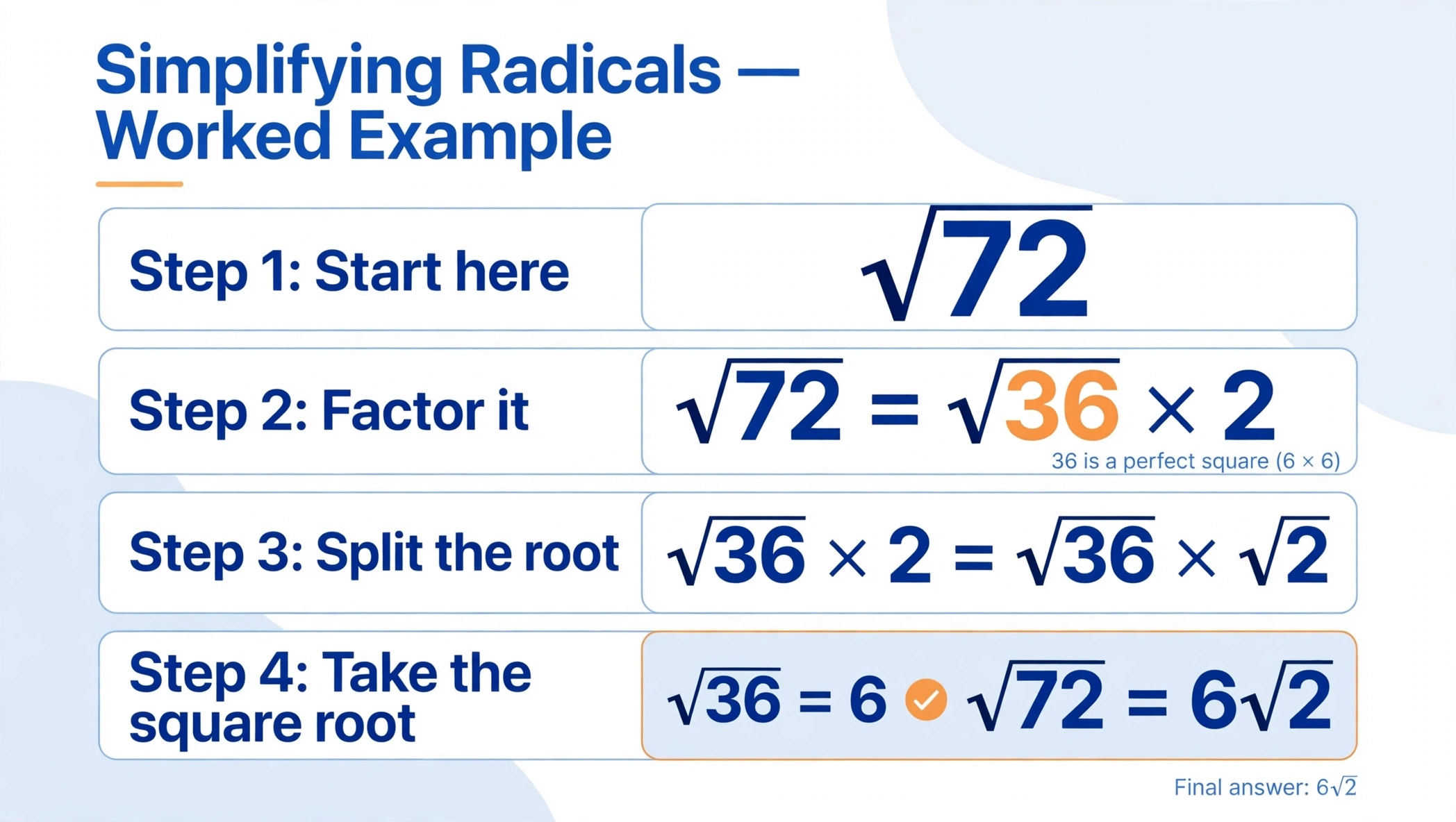
Step 1: Factor the radicand. Break the number under the root into factors, looking for the largest perfect square factor. Perfect squares to know by heart: 4, 9, 16, 25, 36, 49, 64, 81, 100. Our prime factorization calculator shows the full factor tree when you are stuck.
Step 2: Split the root. A product under one root splits into a product of roots: √(a × b) = √a × √b. So √72 becomes √36 × √2.
Step 3: Take the square root of the perfect square. √36 is 6, so √36 × √2 becomes 6√2. Then check: nothing left inside the root is a perfect square, so you are done. Always finish by squaring back: (6√2)² = 36 × 2 = 72. Correct.
Worked examples
Example 1: √50. The largest perfect square factor of 50 is 25. √50 = √25 × √2 = 5√2.
Example 2: √180. 180 = 36 × 5. √180 = √36 × √5 = 6√5.
Example 3: √98. 98 = 49 × 2. √98 = √49 × √2 = 7√2.
Example 4: √12. 12 = 4 × 3. √12 = √4 × √3 = 2√3.
Example 5, with a variable: √(25x²) = √25 × √x² = 5x, for x ≥ 0. Variables with even exponents come out the same way numbers do: halve the exponent.
3 mistakes that cost the most marks
1. Stopping one step early. √72 = √(9 × 8) = 3√8 looks finished but is not, because 8 still hides the perfect square 4. Go one more step: 3√8 = 3 × 2√2 = 6√2.
2. Splitting a sum. Roots do not split over addition. √(9 + 16) is √25 = 5, not 3 + 4 = 7. Only products split.
3. Skipping the check. Square your answer back. If you do not get the original radicand, something went wrong.
Practice problems
Try these yourself first, then check your answers below. 1. √27. 2. √200. 3. √45. 4. √96. 5. √150.
Answers: 1. 3√3. 2. 10√2. 3. 3√5. 4. 4√6. 5. 5√6.
Frequently asked questions
What is simplest radical form? A radical with no perfect square factor left inside, no fraction inside, and no radical in the denominator.
Can every radical be simplified? No. √7 and √11 have no perfect square factors, so they are already in simplest form.
Why factor first? Because the perfect square factor is what comes out of the root. Finding it is the whole job, and factoring is how you find it.
Do I need a calculator for this? No, but our factoring calculator checks your work with steps shown.