Multiply Polynomials Calculator: Expand Step by Step
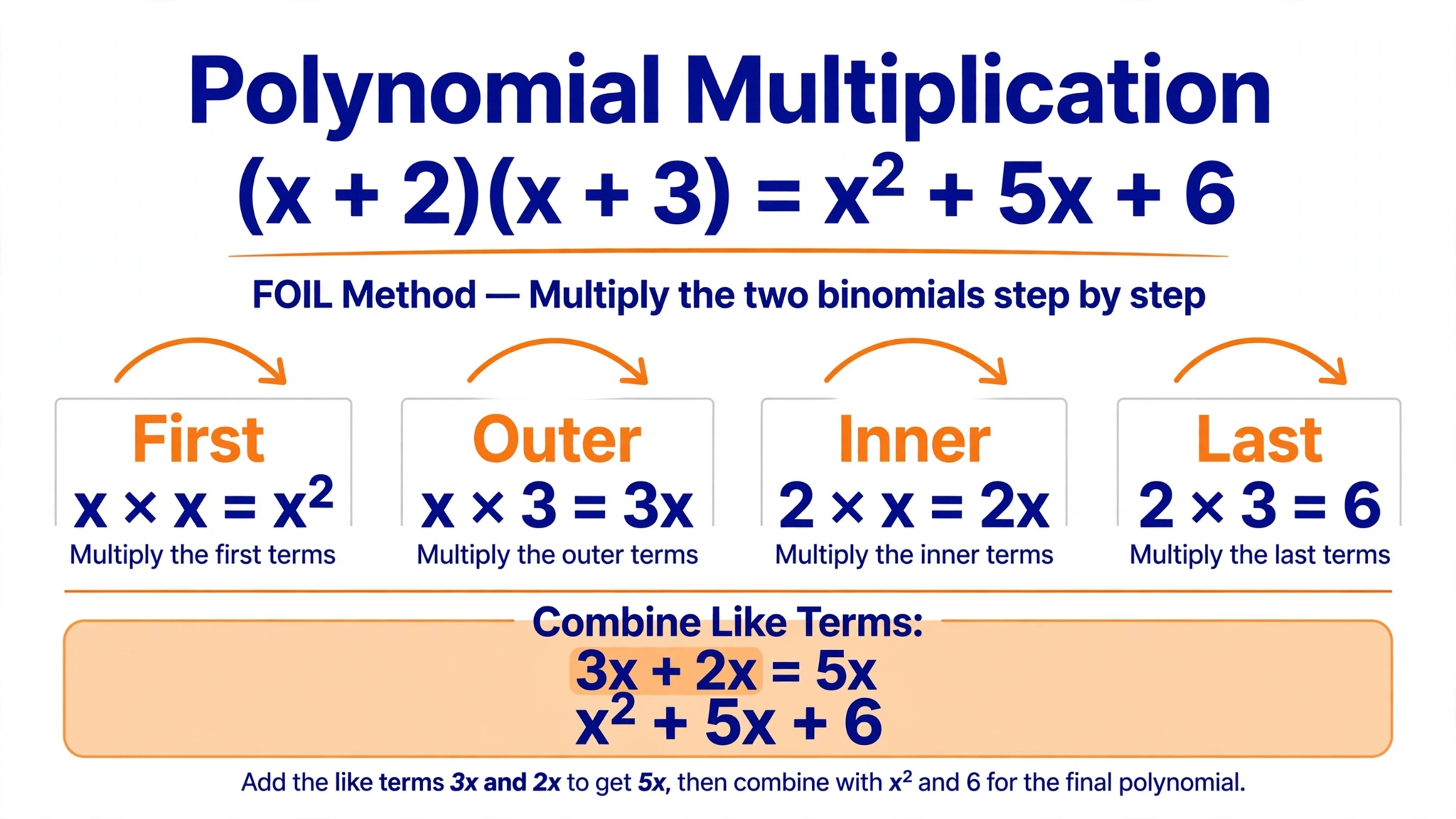
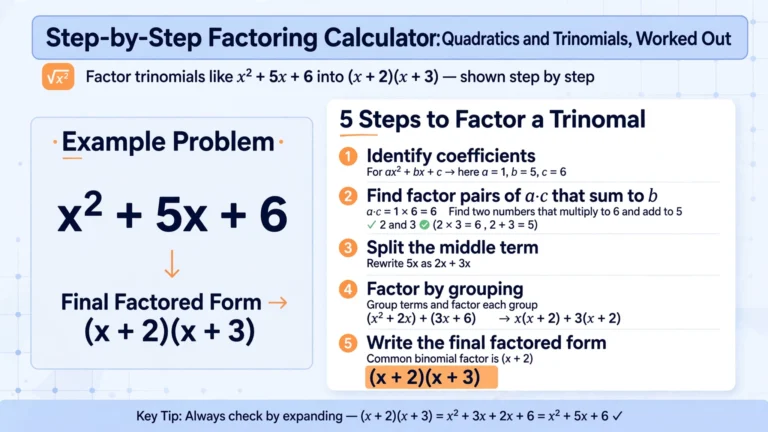
Multiplying polynomials is the reverse of factoring. Factoring takes x² + 5x + 6 and breaks it into (x + 2)(x + 3); multiplying takes (x + 2)(x + 3) and expands it back out to x² + 5x + 6. Every term in the first polynomial must multiply every term in the second. Miss one pairing and the answer is wrong, which is why a careful, written-out method beats doing it in your head.
This guide shows the three methods that cover every case: FOIL for two binomials, the distributive (box) method for anything bigger, and the special patterns that let you skip the work. Each one comes with a fully worked example, the mistakes students make most, and practice problems at the end.
Method 1: FOIL for two binomials
FOIL is a memory aid for multiplying two binomials: multiply the First terms, the Outer terms, the Inner terms, and the Last terms, then add everything up and combine like terms.
Example: (x + 2)(x + 3)
First: x times x = x². Outer: x times 3 = 3x. Inner: 2 times x = 2x. Last: 2 times 3 = 6. Add them: x² + 3x + 2x + 6. Combine the like terms 3x + 2x to get x² + 5x + 6.
FOIL only works when both factors are binomials. For anything larger, use the distributive method below.
Method 2: the distributive method (works on everything)
The distributive method is the general rule: take each term of the first polynomial and multiply it across the entire second polynomial. If you draw a box (grid) with one polynomial along the top and the other down the side, each cell is one term-times-term product, and the sum of all cells is the answer.
Example: (x + 1)(x² + 3x + 2)
Multiply x across the trinomial: x times x² = x³, x times 3x = 3x², x times 2 = 2x. Then multiply 1 across the trinomial: 1 times x² = x², 1 times 3x = 3x, 1 times 2 = 2. Add all six pieces: x³ + 3x² + 2x + x² + 3x + 2. Combine like terms: x³ + 4x² + 5x + 2.
Example: (2x – 3)(x² + 4x – 5)
Multiply 2x across: 2x times x² = 2x³, 2x times 4x = 8x², 2x times -5 = -10x. Then multiply -3 across: -3 times x² = -3x², -3 times 4x = -12x, -3 times -5 = +15. Add them: 2x³ + 8x² – 10x – 3x² – 12x + 15. Combine like terms: 2x³ + 5x² – 22x + 15. Watch the signs on this one: -3 times -5 gives +15, and students lose marks here more than anywhere else.
Our expand and FOIL calculator shows the same distributive expansion with each step written out.
Method 3: special cases worth memorizing
Three patterns appear so often that recognizing them saves real time.
Square of a binomial: (x + 4)² = x² + 8x + 16. In general, (a + b)² = a² + 2ab + b², and (a – b)² = a² – 2ab + b². Our perfect square trinomial guide covers these in both directions.
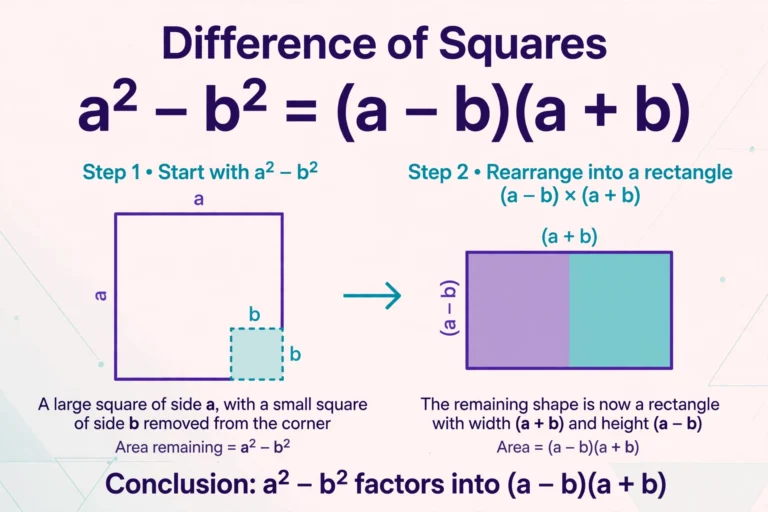
Product of sum and difference: (x + 5)(x – 5) = x² – 25. In general, (a + b)(a – b) = a² – b². The middle terms cancel every time. Our difference of squares guide shows how to spot and use this pattern.
Sum or difference of cubes: (x + 2)(x² – 2x + 4) = x³ + 8. This one is rarer on tests, but the same distributive method handles it.
Common mistakes to avoid
Missing a pairing. In (x + 2)(x² + 3x + 2), there are 2 times 3 = 6 products. If your answer has fewer, you skipped one. Count the pairings before you start.
Sign errors. A minus times a minus is a plus, and a minus times a plus is a minus. Write every sign down instead of tracking it mentally, especially in longer products.
Forgetting to combine like terms. x² + 3x + 2x + 6 is not finished; the answer is x² + 5x + 6. Always scan for like terms at the end.
Squaring term by term. (x + 4)² is NOT x² + 16. It is (x + 4)(x + 4) = x² + 8x + 16. The middle term 2ab is the part everyone forgets.
Try it yourself
Work these out with the distributive method, then expand your answers to check (answers in brackets).
1. (x + 5)(x + 7) [x² + 12x + 35]
2. (x – 4)(x + 9) [x² + 5x – 36]
3. (2x + 3)(x – 5) [2x² – 7x – 15]
4. (x + 2)(x² – 3x + 1) [x³ – x² – 5x + 2]
5. (3x – 2)² [9x² – 12x + 4]
Frequently asked questions
What is the fastest way to multiply two binomials?
FOIL, when both factors are binomials. For anything with three or more terms, the distributive (box) method is the reliable choice.
How is multiplying polynomials related to factoring?
They are inverse operations. Multiplying expands (x + 2)(x + 3) into x² + 5x + 6; factoring compresses x² + 5x + 6 back into (x + 2)(x + 3). If you can do one fluently, the other gets easier. Our step-by-step factoring guide covers the reverse direction.
Do I always need to combine like terms at the end?
Yes. A product is not fully expanded until all like terms are combined. Leaving x² + 3x + 2x + 6 uncombined is an incomplete answer.
Can I multiply polynomials with different variables, like (x + 2)(y + 3)?
Yes, the same method applies: xy + 3x + 2y + 6. There are no like terms to combine across different variables, so that is the final answer.
Multiplying polynomials comes down to one habit: every term times every term, written out, with like terms combined at the end. Build that habit and the reverse skill, factoring, follows naturally. Try any polynomial in our factoring calculator to see the expansion run backwards with steps.