How to Factor Cubic Polynomials: A Step-by-Step Guide
To factor a cubic polynomial, first pull out any GCF, then look for a pattern: four terms means grouping, two terms means sum or difference of cubes. Otherwise, use the rational root theorem to find one root, divide it out with synthetic division, and factor the quadratic that remains. Check your answer by expanding it back.
Which method fits your cubic?
A cubic polynomial has degree 3, so it can split into three linear factors, or into one linear factor and one quadratic. The method you use depends on what the cubic looks like. Read the shape first, then pick the method. The table below is the whole decision in one place.
- A GCF in every term? Pull it out first, then keep factoring what is left.
- Four terms? Use grouping.
- Two terms? Check for sum or difference of cubes.
- Three terms, or none of the above? Use the rational root theorem and synthetic division.
- A quadratic left that will not factor? Stop there. That is a complete answer.
Method 1: Pull out the GCF first
Always check for a GCF before anything else. Factoring a cubic with a GCF still inside is the most common source of half-finished answers. After you pull the GCF out, keep factoring the part inside the brackets.
Example: 2x^3 + 4x^2 + 2x. The GCF is 2x. Pull it out: 2x(x^2 + 2x + 1). The quadratic inside is a perfect square, so it factors again: 2x(x + 1)^2. That is the full answer.
Example: 3x^3 – 6x^2. The GCF is 3x^2. Pull it out: 3x^2(x – 2). Done. If you skip this step, every later method gets harder than it needs to be.
Method 2: Grouping for four terms
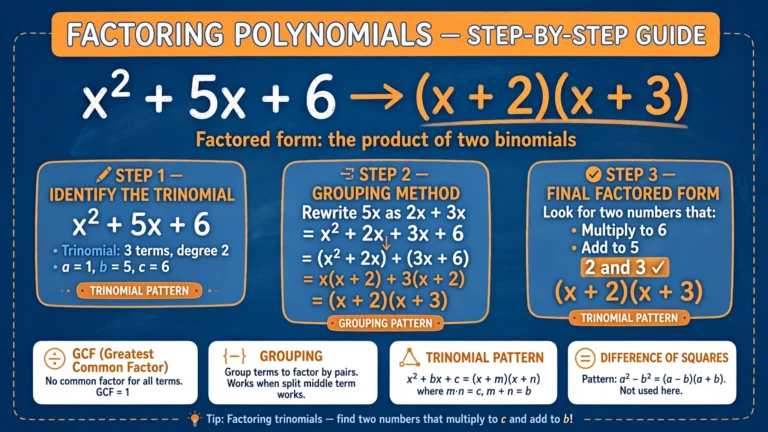
When a cubic has four terms, use grouping: split it into two pairs and factor each pair. If both pairs leave the same bracket, that bracket is a factor.
Example: x^3 – 2x^2 + 3x – 6. First pair: x^2(x – 2). Second pair: 3(x – 2). Both pairs share (x – 2), so the answer is (x – 2)(x^2 + 3). The quadratic x^2 + 3 does not factor over the real numbers, so you stop here.
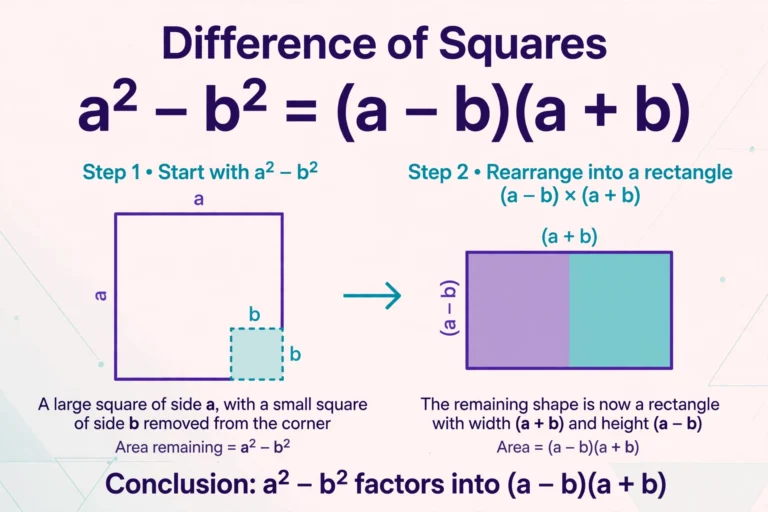
Example: x^3 + 2x^2 – x – 2. First pair: x^2(x + 2). Second pair: -1(x + 2). That gives (x + 2)(x^2 – 1), and x^2 – 1 is a difference of squares, so the full answer is (x + 2)(x – 1)(x + 1).
Method 3: Sum and difference of cubes (short pattern)
Two-term cubics are often a sum or a difference of cubes. The patterns are: a^3 + b^3 = (a + b)(a^2 – ab + b^2), and a^3 – b^3 = (a – b)(a^2 + ab + b^2). Learn the pattern, and these take seconds.
Example: x^3 + 27 = (x + 3)(x^2 – 3x + 9). Example: x^3 – 8 = (x – 2)(x^2 + 2x + 4). The quadratic factor in a sum of cubes or difference of cubes does not factor further over the real numbers, so do not try to force it.
Keep this method in its place. It only handles two-term cubics. For anything else, move on to the rational root theorem below.
Method 4: Rational root theorem and synthetic division
This is the workhorse method. It handles any cubic that the first three methods do not. The rational root theorem says: for a cubic with integer coefficients, any rational root must be a factor of the constant term divided by a factor of the leading coefficient. So you get a short list of candidates to test, and you test them by substitution.
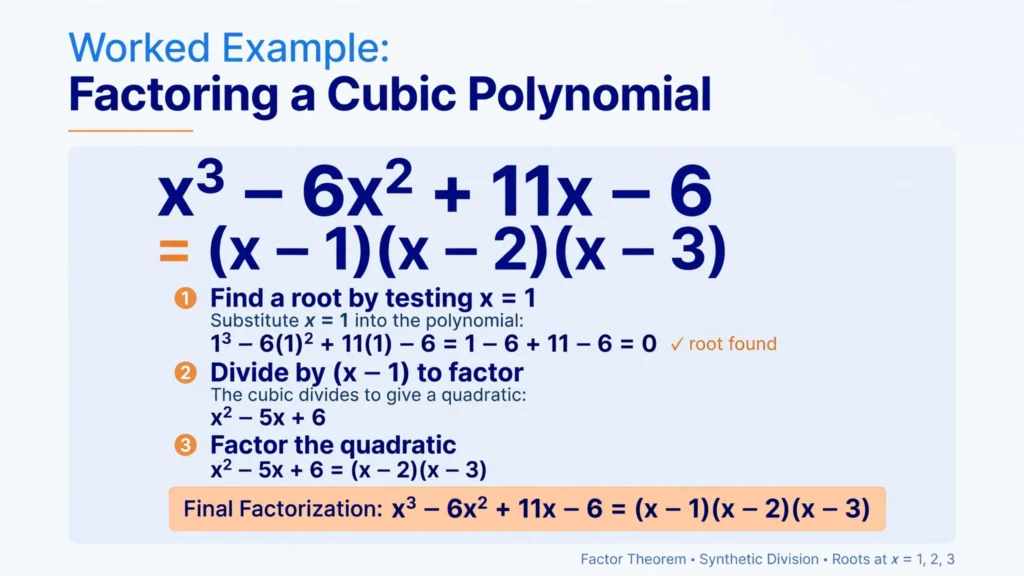
Worked example: x^3 – 6x^2 + 11x – 6. The leading coefficient is 1 and the constant term is -6, so the candidates are 1, -1, 2, -2, 3, -3, 6, -6. Test x = 1: 1 – 6 + 11 – 6 = 0. So x = 1 is a root, which means (x – 1) is a factor.
Now divide the cubic by (x – 1) with synthetic division. The table below shows each step.
| 1 | -6 | 11 | -6 |
| (bring down 1) | multiply by 1 gives 1, add to -6 gives -5 | multiply by 1 gives -5, add to 11 gives 6 | multiply by 1 gives 6, add to -6 gives 0 |
| 1 | -5 | 6 | remainder 0 |
The quotient is x^2 – 5x + 6, and the remainder is 0, which confirms (x – 1) is a factor. Factor the quadratic: x^2 – 5x + 6 = (x – 2)(x – 3). So the full answer is (x – 1)(x – 2)(x – 3). See how to factor polynomials for a full guide.
Second example, with a leading coefficient that is not 1: 2x^3 – 3x^2 – 11x + 6. The candidates are factors of 6 divided by factors of 2: 1, -1, 2, -2, 3, -3, 6, -6, 1/2, -1/2, 3/2, -3/2. Test x = 3: 54 – 27 – 33 + 6 = 0. So (x – 3) is a factor. Synthetic division by 3 on the coefficients 2, -3, -11, 6 gives the quotient 2x^2 + 3x – 2 with remainder 0. That quadratic factors as (2x – 1)(x + 2). So the full answer is (x – 3)(2x – 1)(x + 2). See how to factor trinomials for more examples.
When to stop
Not every cubic splits into three neat linear factors, and that is fine. After grouping or synthetic division you may be left with a quadratic that does not factor over the real numbers. Example: x^3 – 2x^2 + x – 2 groups to (x – 2)(x^2 + 1). The factor x^2 + 1 has no real roots, so in school algebra the factored form stops at (x – 2)(x^2 + 1). Do not force it further.
If no candidate from the rational root theorem works at all, the cubic has no rational root, so it cannot be split into linear factors with rational coefficients. That is a complete answer, not a failure. Move on instead of guessing.
Check your answer by expanding
Always expand your answer back. It takes under a minute and it catches sign errors. Check the first example: (x – 1)(x – 2) = x^2 – 3x + 2. Multiply by (x – 3): x^3 – 3x^2 + 2x – 3x^2 + 9x – 6 = x^3 – 6x^2 + 11x – 6. That matches the original cubic, so the factorization is correct. Try the step-by-step factoring calculator to check your work.
Common mistakes
- Skipping the GCF, which leaves a factorable piece inside the answer.
- Stopping after the first factor. A cubic needs all three roots, or one linear factor plus one quadratic, accounted for.
- Sign errors in synthetic division. Carry the sign at every step, do not drop it.
- Forcing x^2 + 1 or x^2 + 3 to factor. Over the real numbers, they do not.
- Using the rational root theorem on a cubic that already fits grouping or cubes. It works, but it is slower and easier to get wrong.
Practice problems (answers included)
Try these, then check your answers.
- x^3 + 8 = (x + 2)(x^2 – 2x + 4)
- x^3 – 3x^2 + 2x = x(x – 1)(x – 2)
- x^3 – 4x^2 + 5x – 2 = (x – 1)^2(x – 2)
- 2x^3 + x^2 – 5x + 2 = (x – 1)(2x – 1)(x + 2)
- x^3 + 2x^2 – x – 2 = (x + 2)(x – 1)(x + 1)
If you got stuck on any of these, check the step that matches its shape: GCF first, grouping for four terms, cubes for two terms, rational roots for the rest. Use the factoring calculator to check your work.
Frequently asked questions
How do you factor a cubic polynomial? Read the shape first: GCF, then grouping for four terms, cubes for two terms, and the rational root theorem with synthetic division for everything else. Then factor the quadratic that remains and check by expanding.
What is the rational root theorem? It gives you a short list of possible rational roots: factors of the constant term divided by factors of the leading coefficient. Test each candidate by substitution until one gives zero.
How does synthetic division work? You divide a polynomial by (x – r) using only the coefficients. Bring down, multiply, add, repeat. The last number is the remainder, and the rest of the row gives the quotient.
Can every cubic be factored? Every cubic has at least one real root, but it does not always split into three neat linear factors with rational numbers. If the leftover quadratic will not factor, or no rational root exists, that is where the factorization stops.
What if a cubic has no rational root? Then it cannot be split into linear factors with rational coefficients. State that and stop. Guessing a root is not a method.
Related factoring tools
- How to Factor Polynomials
- How to Factor Trinomials
- Factoring by Grouping
- GCF Calculator
- Roots of Polynomial Calculator
- Polynomial Long Division Calculator
Once you can factor a cubic, the same steps carry over to higher-degree polynomials: find one root, divide it out, and repeat. Start with the tool above to check your own examples.