Step-by-Step Factoring Calculator: Quadratics and Trinomials, Worked Out
Most factoring calculators hand you the answer and call it a day. That’s fine for checking a final result, but useless when your teacher asks you to *show your working* — or when you genuinely want to understand the method. This page is the written companion to our step-by-step factoring calculator: real worked examples for quadratics and trinomials, with every decision explained.
The box method for x² + 5x + 6
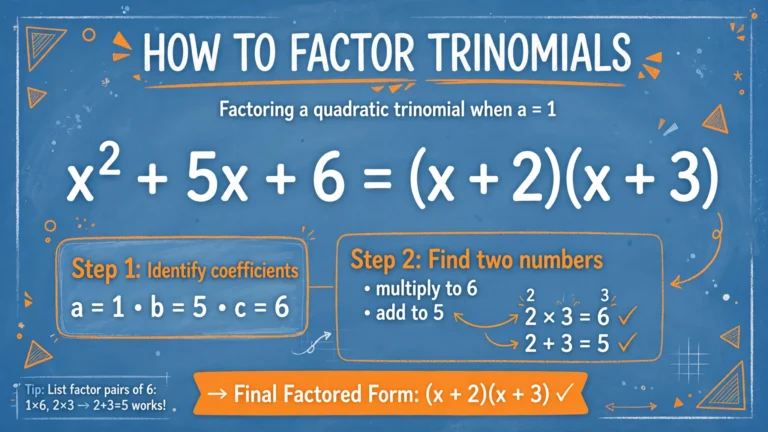
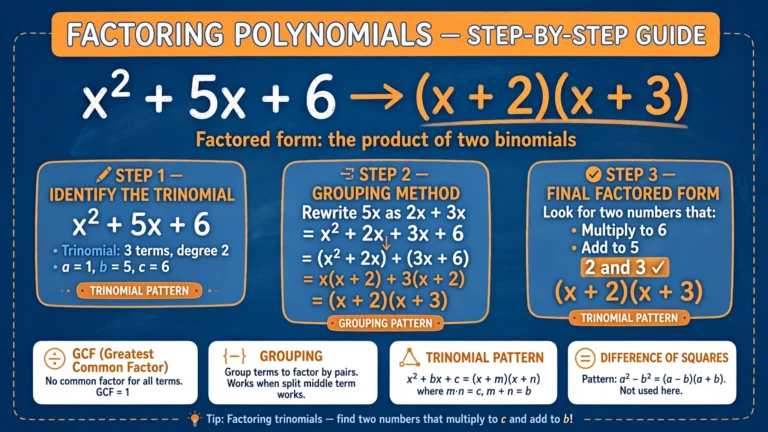
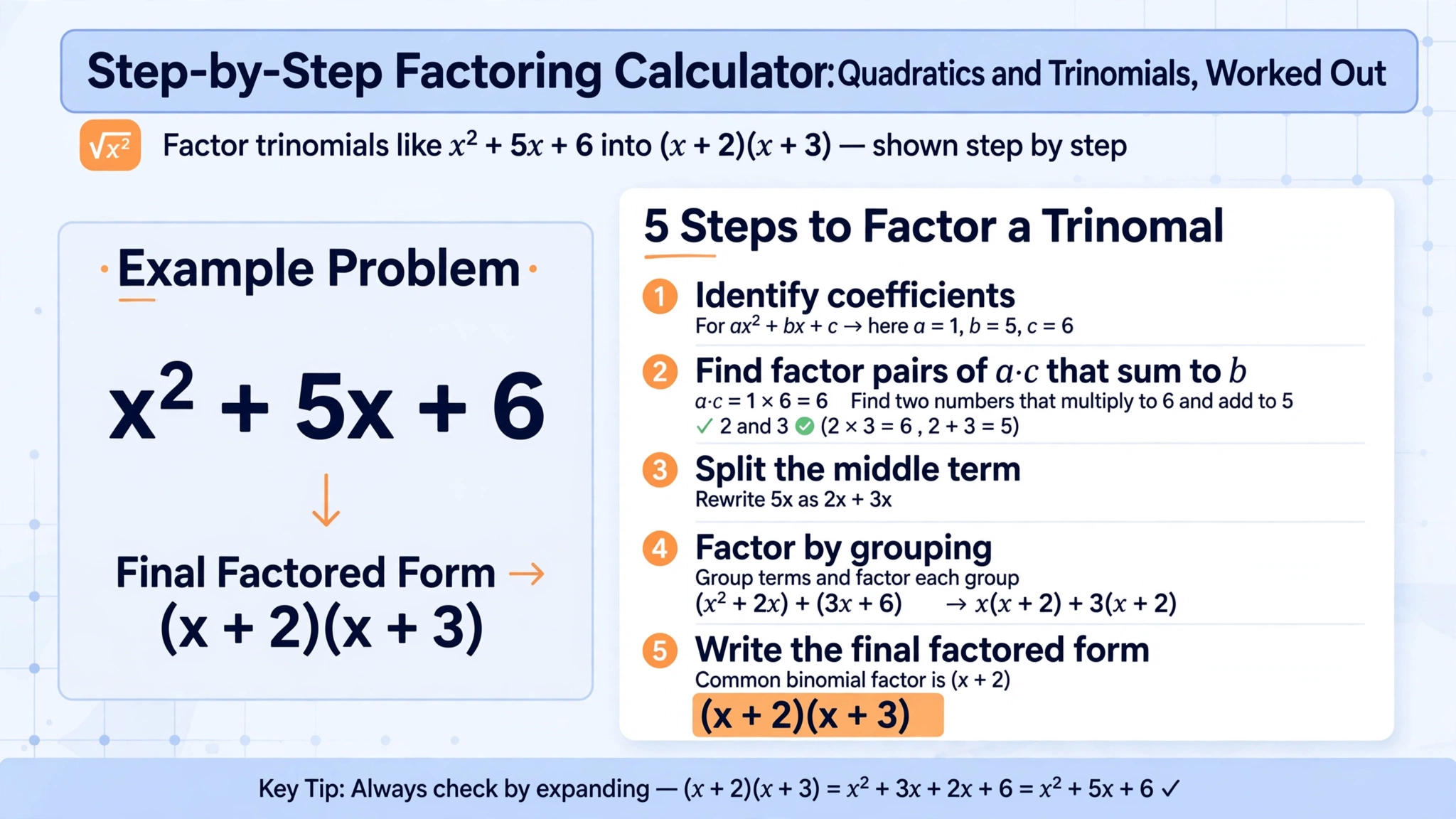
To factor x² + 5x + 6, you need two numbers that multiply to 6 and add to 5. The pairs that multiply to 6: 1×6, 2×3. Which pair adds to 5? 2 + 3 = 5. So:
x² + 5x + 6 = (x + 2)(x + 3)
You can verify in seconds: (x + 2)(x + 3) = x² + 3x + 2x + 6 = x² + 5x + 6. ✓ Our calculator shows this exact reasoning for any quadratic you enter — try it on the simple trinomial calculator (that’s the a = 1 case).
When a ≠ 1: 2x² + 7x + 3
Here the leading coefficient complicates things, so use the ac-method:
- Multiply a·c: 2 × 3 = 6.
- Find two numbers that multiply to 6 and add to b = 7: 1 and 6.
- Split the middle term: 2x² + x + 6x + 3.
- Group: x(2x + 1) + 3(2x + 1) = (x + 3)(2x + 1).
Check: (x + 3)(2x + 1) = 2x² + x + 6x + 3 = 2x² + 7x + 3. ✓ This is exactly what the general trinomial calculator walks through for a ≠ 1 quadratics.
Four terms? Group them: x³ + 2x² + 3x + 6
- Group: (x³ + 2x²) + (3x + 6).
- Factor each group: x²(x + 2) + 3(x + 2).
- The common binomial (x + 2) factors out: (x² + 3)(x + 2).
See the factoring by grouping calculator for more of these.
What if it doesn’t factor nicely?
Not every quadratic factors over the integers — x² + x + 1 has no real factors at all. When that happens, the calculator says so instead of guessing, and the quadratic formula calculator gives you the roots anyway. For higher-degree polynomials, the roots of a polynomial calculator and polynomial long division calculator pick up where factoring leaves off.
Practice checklist
- Always look for a GCF first — it makes everything after it easier.
- For x² + bx + c, find two numbers with product c and sum b.
- For ax² + bx + c with a ≠ 1, use the ac-method.
- Four terms usually means grouping.
- Always expand your answer to check — it takes ten seconds and catches sign errors.
Run any of these through the main factoring calculator to see each step written out, or explore all tools on the calculators page.