How to Factor Trinomials: A Step-by-Step Guide
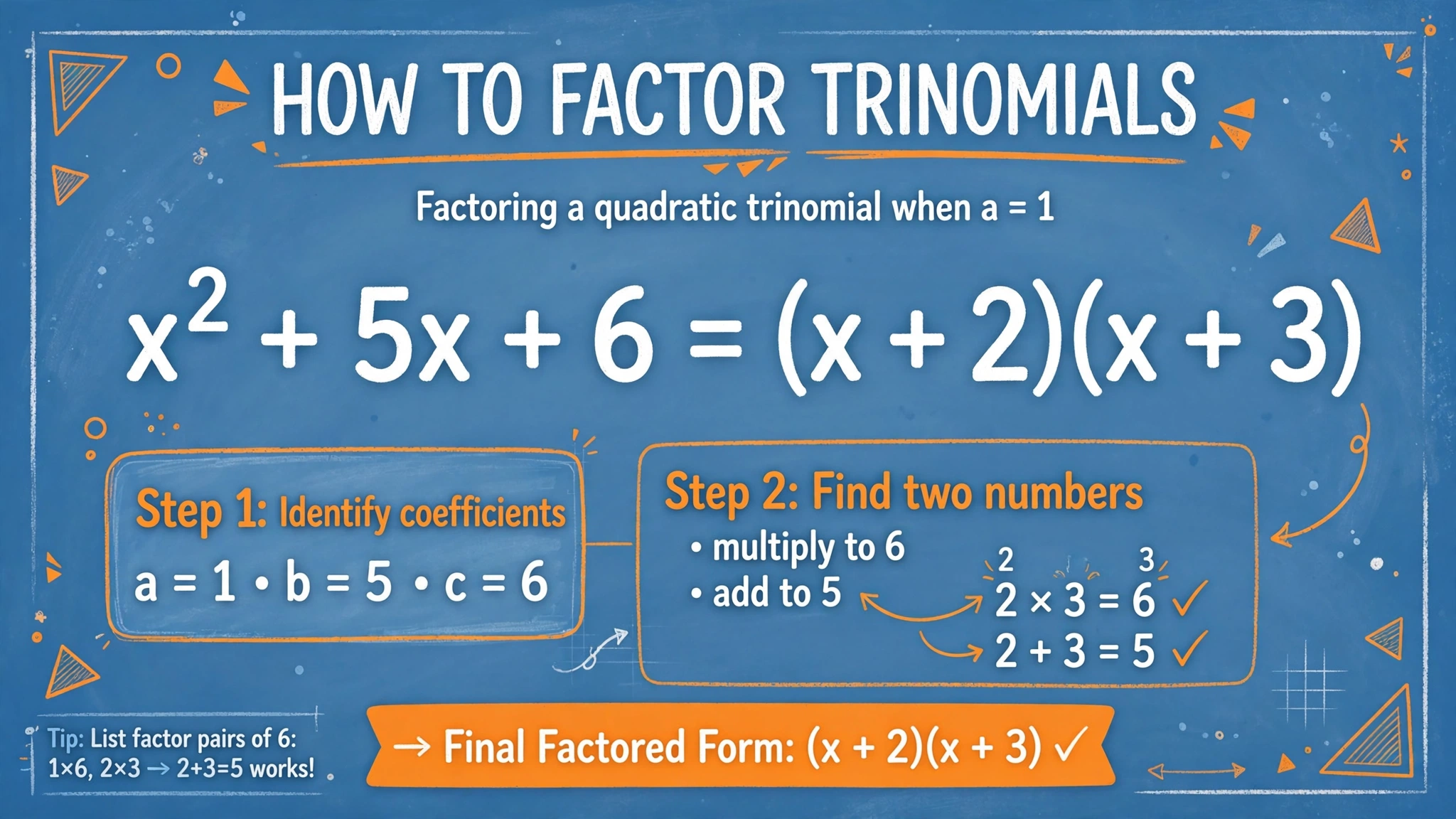
Factoring a trinomial means turning a quadratic expression like x² + 5x + 6 into two binomials multiplied together, in this case (x + 2)(x + 3). It is the fastest way to solve most quadratic equations you meet in school, and once the method clicks it takes under a minute per problem.
This guide covers both cases you will run into: trinomials where the x² coefficient is 1, and trinomials with a leading coefficient (the harder kind, where a is not 1). You get the exact steps, sign rules, worked examples, the mistakes that cost students the most points, and practice problems at the end.
The parts of a trinomial
Every quadratic trinomial follows the form ax² + bx + c:
- a is the leading coefficient, the number in front of x²
- b is the middle coefficient, the number in front of x
- c is the constant term at the end
In 2x² + 7x + 3, a = 2, b = 7, c = 3. In x² – 9x + 14, a = 1, b = -9, c = 14. Spotting a, b, and c correctly is step zero of every factoring problem, because the sign of each one controls which method you use and which signs end up in the answer.
Case 1: factoring when a = 1
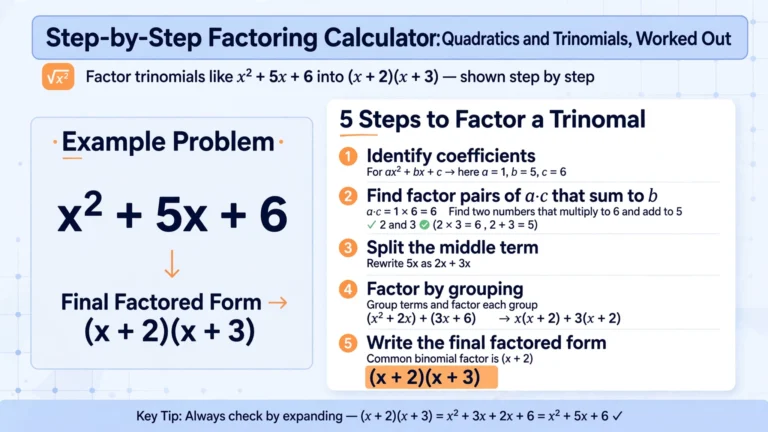
When the x² coefficient is 1, the job is simple. You need two numbers that multiply to c and add to b. That pair, call them m and n, gives you the factored form (x + m)(x + n). Try it on our simple trinomial calculator to check each answer as you learn.
Worked example: factor x² + 5x + 6
Step 1: read off b and c. Here b = 5 and c = 6.
Step 2: list the factor pairs of 6: 1 and 6, 2 and 3.
Step 3: find the pair that adds to 5. 1 + 6 = 7 (no), 2 + 3 = 5 (yes).
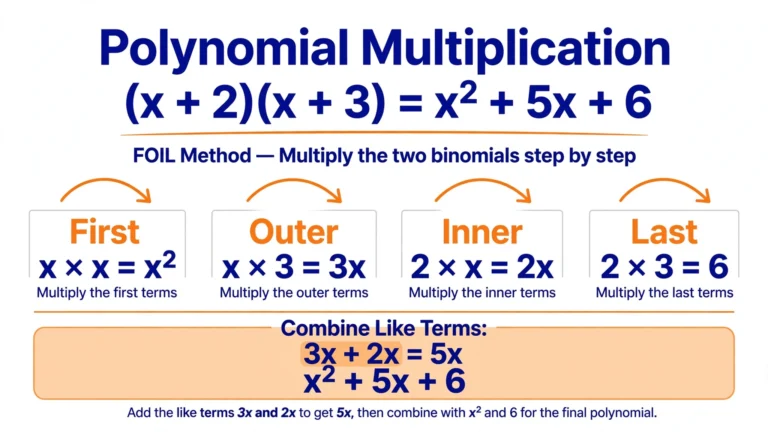
Answer: (x + 2)(x + 3). A quick FOIL check confirms it: (x + 2)(x + 3) = x² + 3x + 2x + 6 = x² + 5x + 6.
The whole method is just those three steps: name b and c, list factor pairs of c, pick the pair that adds to b. Most textbook problems in this section are built to work out cleanly, so if no pair fits, the trinomial is probably prime (more on that below).
Case 2: factoring with a leading coefficient (a is not 1)
This is where students usually get stuck. In 2x² + 7x + 3, the plain product-sum method does not apply directly, because the leading 2 changes the arithmetic. The fix is the AC method: you turn the harder problem back into a grouping problem. Our general trinomial calculator runs these steps for you, and our AC method guide goes deeper.
Worked example: factor 2x² + 7x + 3
Step 1: multiply a and c. 2 x 3 = 6.
Step 2: find two numbers that multiply to 6 and add to b (7). That is 1 and 6.
Step 3: split the middle term with those numbers: 2x² + x + 6x + 3.
Step 4: factor by grouping. From the first two terms take out x: x(2x + 1). From the last two take out 3: 3(2x + 1). Both groups share (2x + 1), so the answer is (2x + 1)(x + 3).
Check: (2x + 1)(x + 3) = 2x² + 6x + x + 3 = 2x² + 7x + 3. The method works every time a factorable pair exists, no matter how large a gets. One habit saves a lot of grief here: factor out a greatest common factor from the whole expression first, so the numbers stay small.
Sign rules for factoring trinomials
The signs of b and c decide the signs inside your binomials. Memorize this table and half the “hard” problems become easy:
| Signs in the trinomial | Signs in the factors | Example |
|---|---|---|
| b positive, c positive | both positive | x² + 8x + 15 = (x + 3)(x + 5) |
| b negative, c positive | both negative | x² – 9x + 14 = (x – 2)(x – 7) |
| c negative | one positive, one negative | x² + 4x – 21 = (x + 7)(x – 3) |
The logic is plain arithmetic. A positive c means the two numbers share a sign (their product is positive), and then b picks which sign: positive b means both positive, negative b means both negative. A negative c forces opposite signs, and the larger number takes the sign of b.
4 mistakes that cost students the most points
1. Skipping the GCF check. In 4x² + 18x + 8, everything is divisible by 2. Factor it out first to get 2(2x² + 9x + 4), then factor the inside. Students who skip this end up hunting factor pairs of 32 instead of 8.
2. Getting the signs backwards with a negative c. For x² + 2x – 8, the factors must have opposite signs: (x + 4)(x – 2), not (x + 4)(x + 2). Check: 4 x (-2) = -8 and 4 + (-2) = 2. The sign table above prevents this.
3. Stopping one step early on the AC method. After grouping you must have one shared binomial factor in both groups. If the two groups give you (2x + 1) and (2x + 1), combine them into a product. If they give you two different binomials, your number pair was wrong, so go back to step 2.
4. Forgetting to verify. Multiply your answer back out with FOIL. It takes ten seconds and catches most sign errors before they cost marks.
When a trinomial does not factor
Some trinomials are prime over the integers: no two whole numbers multiply to c while adding to b. x² + 5x + 3 is one, because the factor pairs of 3 (only 1 and 3) add to 4, not 5. That is a valid answer, not a failure. When factoring does not work, the quadratic formula still gives you the roots. One related pattern to know: a trinomial like x² + 6x + 9 is a perfect square trinomial, which factors as (x + 3)², a shortcut worth recognizing on sight.
Practice problems
Try these, then check your answers with the calculators linked above.
- x² + 8x + 15 (Answer: (x + 3)(x + 5))
- x² – 9x + 14 (Answer: (x – 2)(x – 7))
- x² + 4x – 21 (Answer: (x + 7)(x – 3))
- 3x² + 11x + 6 (Answer: (3x + 2)(x + 3))
- 2x² – 5x – 12 (Answer: (2x + 3)(x – 4))
- x² + 6x + 5 (Answer: (x + 1)(x + 5))
Frequently asked questions
What is the fastest way to factor x² + bx + c?
Use the product-sum method: find two numbers that multiply to c and add to b, then write (x + m)(x + n). With practice it takes under a minute.
How do I factor a trinomial when the leading coefficient is not 1?
Use the AC method: multiply a and c, find two numbers that multiply to that product and add to b, split the middle term, and factor by grouping. The full steps are worked out in the example above.
Can every trinomial be factored?
No. Trinomials like x² + 5x + 3 have no integer factor pair that fits, so they are prime over the integers. The quadratic formula handles those cases.
How do I know which signs to use in the factors?
If c is positive, both factors share the sign of b. If c is negative, the factors have opposite signs, and the larger number takes the sign of b.
What is the difference between factoring a trinomial and using the quadratic formula?
Factoring is faster when the numbers work out, and it shows the structure of the expression. The quadratic formula always works but takes longer. Students usually factor first and keep the formula as the backup.
Where does factoring trinomials get used?
Solving quadratic equations is the main one: x² + 5x + 6 = 0 becomes (x + 2)(x + 3) = 0, so x = -2 or x = -3. It also shows up in area problems, projectile motion, and anywhere quadratics model something real.
Related factoring tools
- Simple Trinomial Calculator (a = 1) – factor x² + bx + c with steps
- General Trinomial Calculator (a is not 1) – the AC method, worked out
- Difference of Squares Calculator Guide – the a² – b² pattern
- Factor Tree Calculator – prime factorization, visualized
Factoring trinomials comes down to two recipes. When a = 1, find the pair that multiplies to c and adds to b. When a is not 1, run the AC method: multiply a and c, find the pair, split the middle term, group. Learn those two, respect the sign rules, check every answer with FOIL, and quadratics stop being scary.