Rational Expressions Calculator: Simplify Step by Step
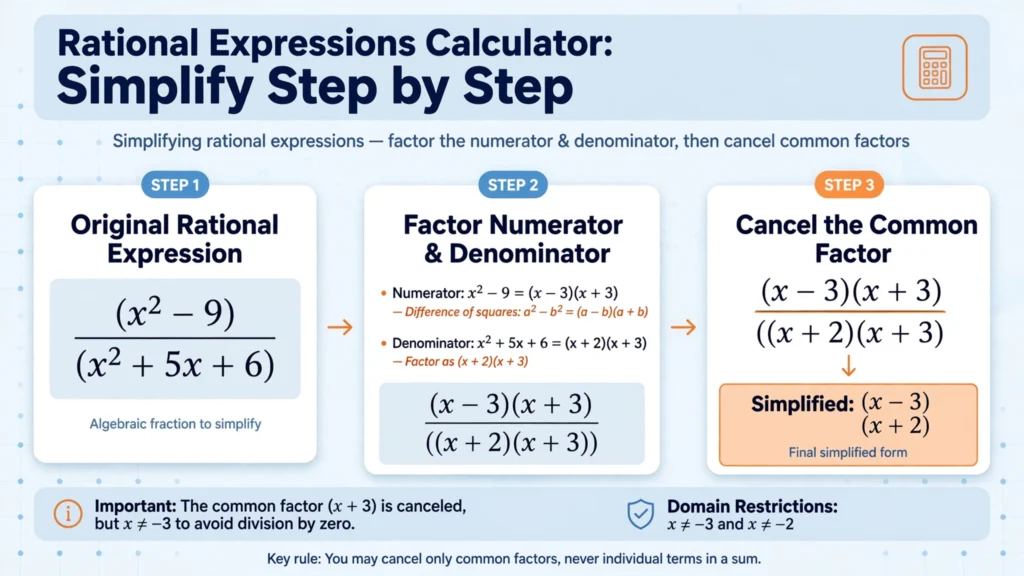
A rational expression is just a fraction where the top and bottom are polynomials, things like (x² – 9) / (x² + 3x). Simplifying one means cancelling the factors the numerator and denominator share, exactly like reducing 6/8 to 3/4, except the “numbers” are algebraic expressions.
The whole trick fits in three moves:
- Factor the numerator completely. Pull out any GCF first, then factor what is left (trinomials, difference of squares, grouping, the usual suspects).
- Factor the denominator completely. Same idea. Do not skip the GCF here either; it is the step most people forget.
- Cancel the common factors. Whatever appears in both top and bottom cancels out. What is left is the simplified form, but note any values that would have made the original denominator zero, because those stay excluded.
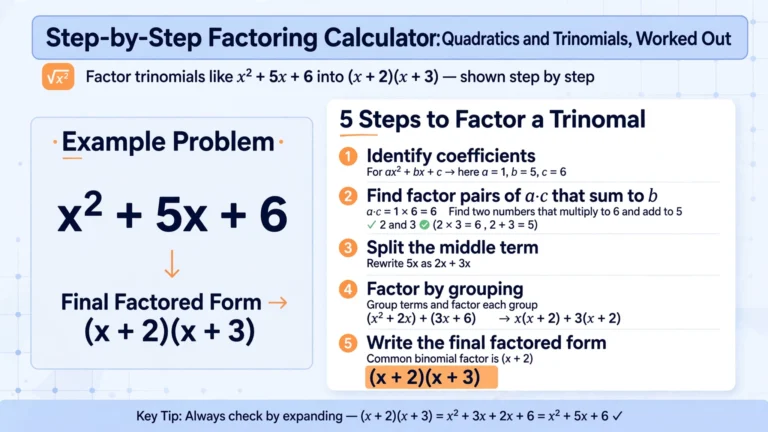
If you are rusty on factoring, our factoring calculator breaks any polynomial into its factors with step-by-step working, and the GCF calculator handles the first move for you.
Worked example 1: (x² – 9) / (x² + 3x)
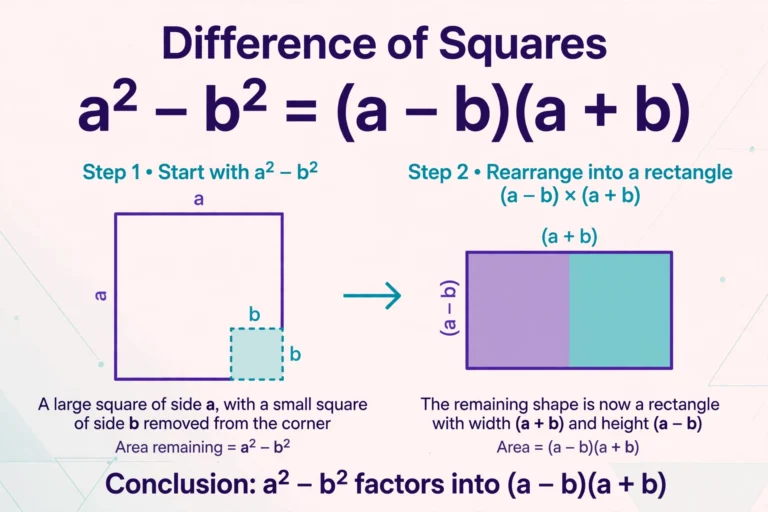
Step 1: factor the numerator. x² – 9 is a difference of squares: (x – 3)(x + 3).
Step 2: factor the denominator. x² + 3x has a common factor of x: x(x + 3).
Step 3: cancel. (x – 3)(x + 3) / x(x + 3). The (x + 3) cancels, leaving (x – 3) / x.
Step 4: domain. The original denominator x² + 3x is zero when x = 0 or x = -3, so the simplified expression is (x – 3) / x with x ≠ 0, -3.
Worked example 2: (2x² + 8x) / (x² – 16)
Step 1: factor the numerator. Pull out the GCF 2x: 2x(x + 4).
Step 2: factor the denominator. x² – 16 is a difference of squares: (x – 4)(x + 4).
Step 3: cancel. 2x(x + 4) / (x – 4)(x + 4). The (x + 4) cancels, leaving 2x / (x – 4).
Step 4: domain. The original denominator is zero when x = 4 or x = -4, so x ≠ 4, -4. Notice the numerator’s coefficient 2 survives: cancelling factors never touches the numbers multiplying them.
Worked example 3: (x² + 5x + 6) / (x² – 4)
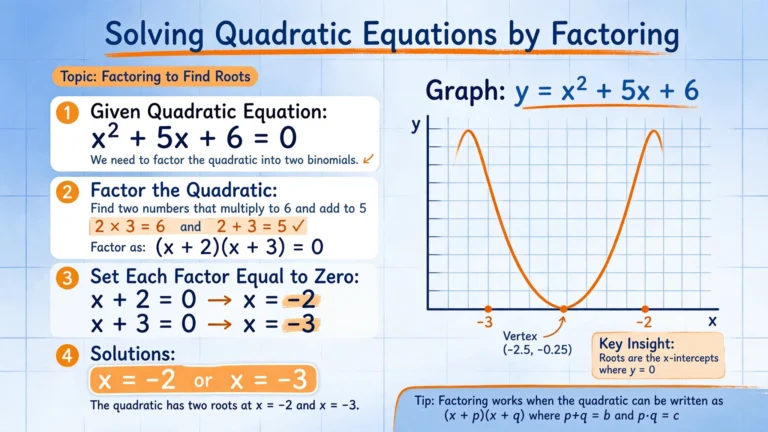
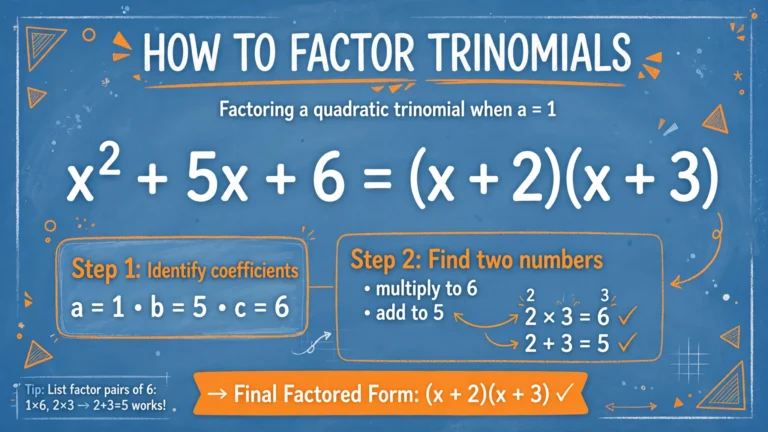
Step 1: factor the numerator. x² + 5x + 6 is a simple trinomial: (x + 2)(x + 3). (Need the method? See our guide to factoring trinomials.)
Step 2: factor the denominator. x² – 4 is a difference of squares: (x – 2)(x + 2).
Step 3: cancel. (x + 2)(x + 3) / (x – 2)(x + 2). The (x + 2) cancels, leaving (x + 3) / (x – 2).
Step 4: domain. The original denominator x² – 4 is zero when x = 2 or x = -2, so the answer is (x + 3) / (x – 2) with x ≠ 2, -2.
Multiplying and dividing rational expressions
Once you can simplify, multiplying and dividing are the same skill with one extra step at the start.
Multiplying: factor every numerator and denominator first, then cancel any factor that appears in both a numerator and a denominator, then multiply what is left. Example: (x² – 9) / (x + 5) x (x + 5) / (x – 3) = (x – 3)(x + 3) / (x + 5) x (x + 5) / (x – 3). Cancel (x + 5) and (x – 3) to get x + 3, with x ≠ -5, 3.
Dividing: flip the second fraction and multiply. (x² – 4) / (x + 1) ÷ (x + 2) / (x + 1) becomes (x – 2)(x + 2) / (x + 1) x (x + 1) / (x + 2) = x – 2, with x ≠ -1, -2.
The domain rule still applies: excluded values come from every denominator you started with, including the flipped one.
Adding and subtracting rational expressions
Adding rational expressions works like adding ordinary fractions: you need a common denominator first. The reliable way to find it is to factor each denominator, then build the least common denominator from the distinct factors, using the highest power of each one that appears.
Example: 3 / (x² – 9) + 2 / (x + 3)
Step 1: factor the denominators. x² – 9 = (x – 3)(x + 3), and x + 3 is already factored. Step 2: the least common denominator is (x – 3)(x + 3). Step 3: rewrite each fraction. The first already has the full denominator. The second needs (x – 3) top and bottom: 2(x – 3) / ((x – 3)(x + 3)). Step 4: add the numerators: (3 + 2(x – 3)) / ((x – 3)(x + 3)) = (3 + 2x – 6) / ((x – 3)(x + 3)) = (2x – 3) / (x² – 9). Step 5: check the domain. x = 3 and x = -3 make the original denominators zero, so both stay excluded.
For subtraction the only extra danger is the minus sign: it applies to the entire numerator of the second fraction, so use parentheses when you combine. A missing pair of parentheses around a subtracted numerator is the most common error in this whole topic.
Worked example 4: (x² + 2x – 8) / (x² – 2x – 3)
Step 1: factor the numerator. Two numbers that multiply to -8 and add to 2: 4 and -2, so the numerator is (x + 4)(x – 2). Step 2: factor the denominator. Two numbers that multiply to -3 and add to -2: -3 and 1, so the denominator is (x – 3)(x + 1). Step 3: look for common factors. (x + 4)(x – 2) over (x – 3)(x + 1) share nothing, so the expression is already in lowest terms. Step 4: note the domain. x = 3 and x = -1 make the denominator zero, so both are excluded.
This example is worth studying because the answer is “it does not simplify.” Factoring both parts is still how you prove that, and on a test, showing the factored form earns the working marks even when nothing cancels. Our trinomial factoring guide walks through the product-sum method used above.
Common mistakes to avoid
- Cancelling terms instead of factors. You can only cancel factors that multiply the whole numerator and denominator. In (x + 5) / (x + 2), nothing cancels, even though x appears in both.
- Forgetting the GCF. (2x² + 4x) / (x² – 4) needs the 2x pulled out first; without it the cancellation never appears.
- Ignoring the domain. The simplified form can hide restrictions. Always read restrictions from the original expression before cancelling, and keep them attached to your answer.
- Losing track of coefficients. In example 2 above, the 2 in 2x / (x – 4) is part of the answer. Cancelling a factor does not cancel the numbers multiplied by it.
Try it yourself
Enter any rational expression into our rational expressions calculator: it factors both parts, cancels, and lists the domain restrictions, all with steps shown. For trickier numerators, the general trinomial calculator and factoring by grouping calculator cover the factoring side. Browse every tool on the calculators page.
Frequently asked questions
When is a rational expression undefined?
Whenever its denominator equals zero. Solve denominator = 0 and exclude those x-values from the domain, even after simplifying.
Can I cancel terms that are added, like the x in (x + 5) / (x + 2)?
No. You can only cancel factors, things multiplied by the whole top and bottom. Added or subtracted terms never cancel.
Do excluded values change after I simplify?
No. The domain is decided by the original expression. Simplifying cannot add values back, so carry every restriction to the final answer.
What if the numerator and denominator share no factors?
Then the expression is already in lowest terms. Factoring both parts is still how you check: if nothing matches, you are done.
How do I multiply or divide rational expressions?
Factor everything first, cancel common factors across numerators and denominators, then multiply. For division, flip the second fraction and multiply instead.
Simplifying rational expressions is three moves: factor the top, factor the bottom, cancel what they share, and never forget the domain. Master those and every rational expression problem, multiplying, dividing, or simplifying, is the same routine.