A factor tree is the method every math class uses to break a number into prime factors: you keep splitting a number into factor pairs until nothing is left but primes. It is simple, visual, and easy to mess up if you stop splitting too early. Our free factor tree calculator builds the whole tree for you, showing every split, and finishes with the prime factorization.
How a factor tree works
Start with your number. Split it into any two factors. Split each of those again. Keep going until every branch ends in a prime number. Circle or box the primes; those are your prime factorization.
The key fact that makes factor trees reliable: it does not matter which factor pair you pick at any step. Different trees for the same number always end with the same prime factorization.
Worked example: 72
Start: 72. Split into 8 × 9.
Split 8 into 2 × 4, and 9 into 3 × 3. Now we have 2 × 4 × 3 × 3.
Split 4 into 2 × 2. Now: 2 × 2 × 2 × 3 × 3. Everything is prime, so we stop.
Prime factorization of 72: 2³ × 3². Check: 8 × 9 = 72, and 2 × 2 × 2 × 3 × 3 = 72.
Worked example: 60
Start: 60. Split into 6 × 10.
Split 6 into 2 × 3, and 10 into 2 × 5. Now: 2 × 3 × 2 × 5. All primes.
Prime factorization of 60: 2² × 3 × 5. Check: 4 × 3 × 5 = 60.
Notice both examples could have started differently. 60 = 12 × 5 works just as well; you would still end at 2² × 3 × 5 after splitting the 12.
Two ways this goes wrong
- Stopping too early. If you split 72 into 8 × 9 and write the answer as “8 and 9”, you are not done. 8 and 9 are composite; only primes count. Circle the primes as you go so you never leave a composite un-split.
- Forgetting the exponents. 2 × 2 × 2 × 3 × 3 is correct but hard to read and easy to miscount. Always condense repeated primes into exponents: 2³ × 3².
What factor trees are for
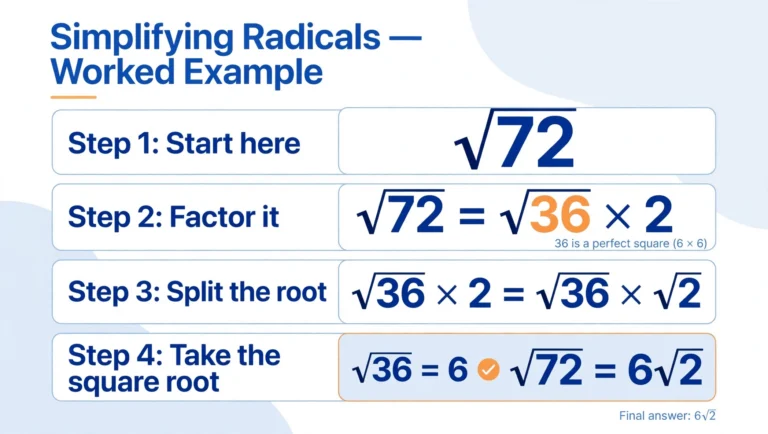
Prime factorizations are not busywork; they feed directly into other calculations. The GCF of two numbers comes from the primes they share, which our GCF calculator computes from the same idea. The LCM comes from the union of the primes, covered by our LCM calculator. Simplifying radicals and canceling fractions also starts with prime factors. For the full algorithm without the tree picture, try our prime factorization calculator.
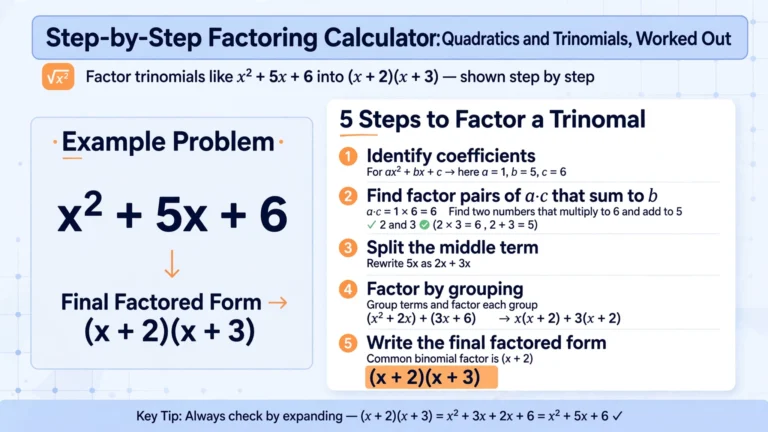
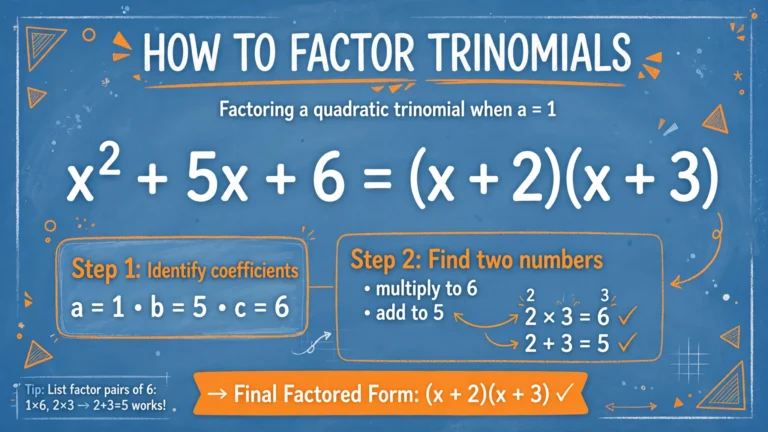
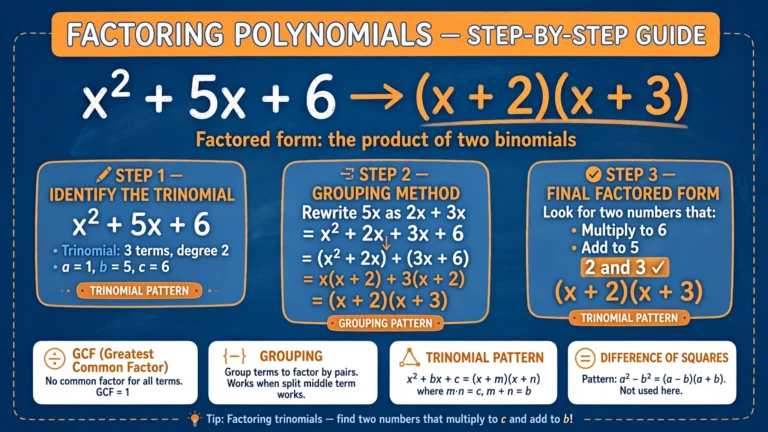
If your factoring involves variables instead of plain numbers, like an expression such as 6x² + 7x + 2, the AC method calculator is the matching tool for ax² + bx + c trinomials. Our step-by-step factoring calculator handles any polynomial, and the main factoring calculator is the fastest starting point. See every tool on the calculators page.