How to Solve Quadratic Equations by Factoring: A Step-by-Step Guide
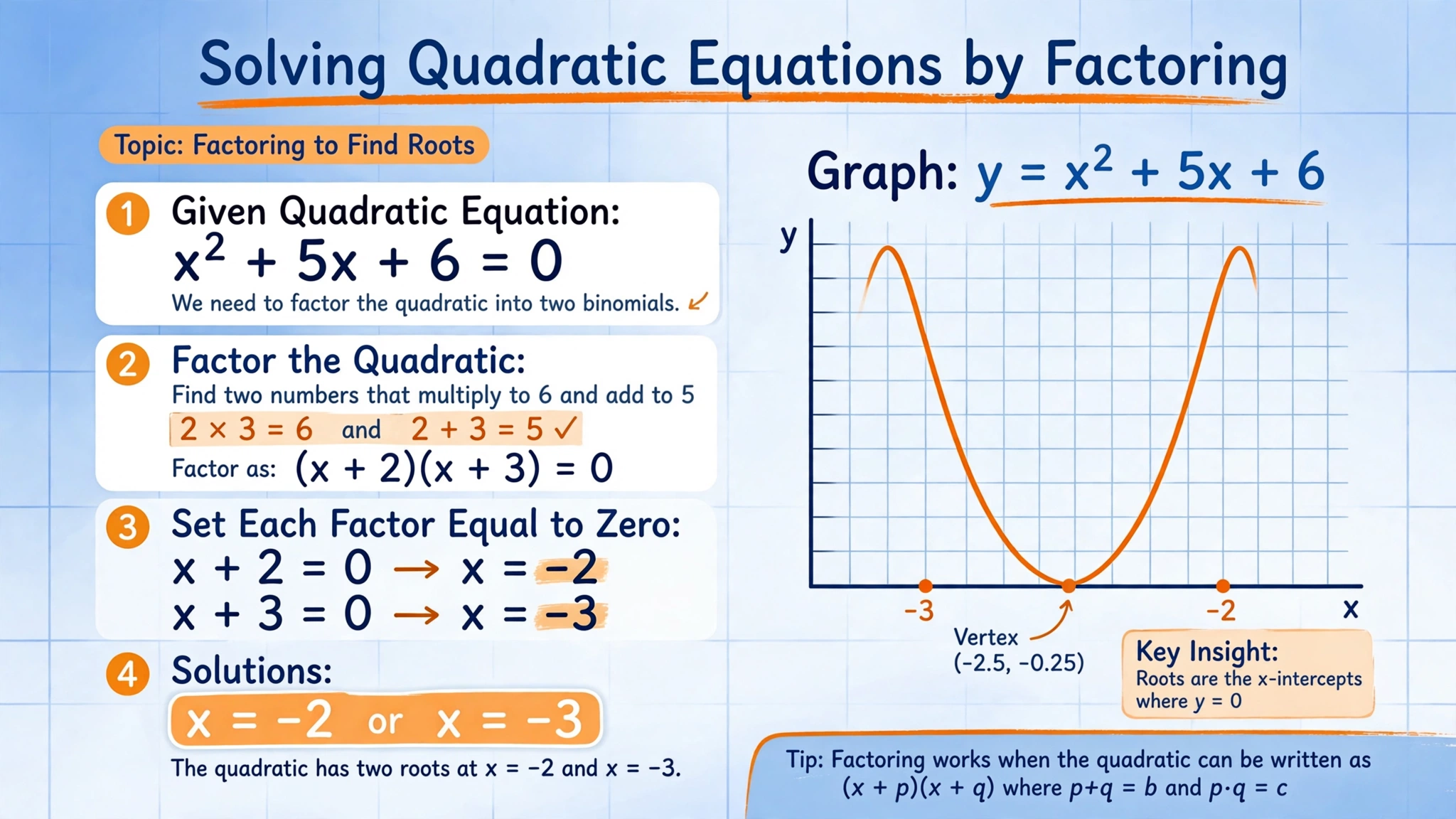
Solving a quadratic equation by factoring means rewriting the equation as a product of factors set equal to zero, then reading off the solutions. Take x² + 5x + 6 = 0. Factor the left side into (x + 2)(x + 3) = 0, and the answers fall out: x = -2 or x = -3. No formula to memorize, no square roots, just factoring and one simple rule.
Of all the ways to solve quadratics, factoring is the fastest when it works, which is most of the time in school algebra. This guide gives you the rule that makes it work, the three steps, fully worked examples for every case you will meet, the mistakes that cost students the most marks, and practice problems at the end.
The one idea that makes it work: the zero product property
The whole method rests on a single fact: if two things multiply to zero, at least one of them must be zero. In symbols, if A x B = 0, then A = 0 or B = 0 (or both). There is no other way to get a product of zero.
That is why factoring solves equations. Once you have (x + 2)(x + 3) = 0, the zero product property says either x + 2 = 0 or x + 3 = 0. Solve each tiny equation and you have both answers: x = -2 and x = -3. Every example in this guide is just this idea applied to different quadratics.
The 3-step method
Step 1: get everything on one side. The equation must look like (some quadratic) = 0 before you factor. If it does not, move all terms to one side first. For example, x² + 5x = -6 becomes x² + 5x + 6 = 0.
Step 2: factor the quadratic completely. Pull out a greatest common factor first if there is one, then factor what is left. Our factoring calculator does this with steps shown if you want to check your work.
Step 3: set each factor equal to zero and solve. Use the zero product property on every factor, then solve the little linear equations that result.
That is the entire method. The rest is practice recognizing which factoring pattern each quadratic needs.
Example 1: x² + 5x + 6 = 0 (leading coefficient 1)
This is the most common case. The equation is already in the form (quadratic) = 0, so start factoring.
Step 1: nothing to move. The right side is already 0.
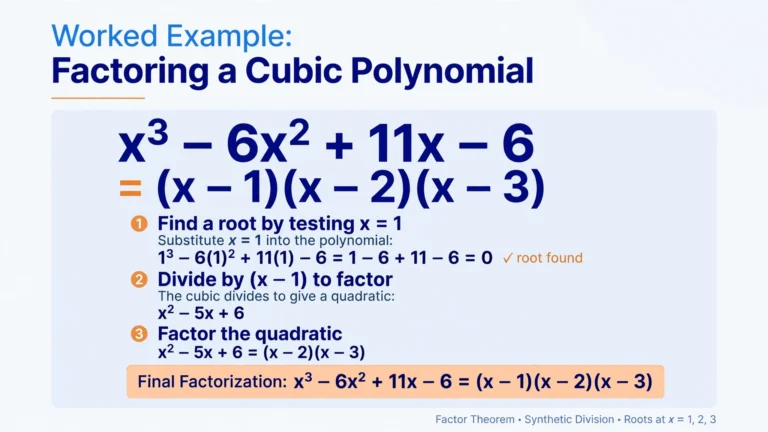
Step 2: factor x² + 5x + 6. You need two numbers that multiply to 6 and add to 5: 2 and 3. So x² + 5x + 6 = (x + 2)(x + 3). (This is the product-sum method, covered in full in our guide to factoring trinomials.)
Step 3: (x + 2)(x + 3) = 0. Set each factor to zero: x + 2 = 0 gives x = -2, and x + 3 = 0 gives x = -3.
Check both in the original: (-2)² + 5(-2) + 6 = 4 – 10 + 6 = 0, and (-3)² + 5(-3) + 6 = 9 – 15 + 6 = 0. Both work.
Example 2: 2x² + 7x + 3 = 0 (leading coefficient is not 1)
When the x² coefficient is not 1, the plain product-sum method does not apply directly. Use the AC method instead.
Step 1: the equation is already set to zero.
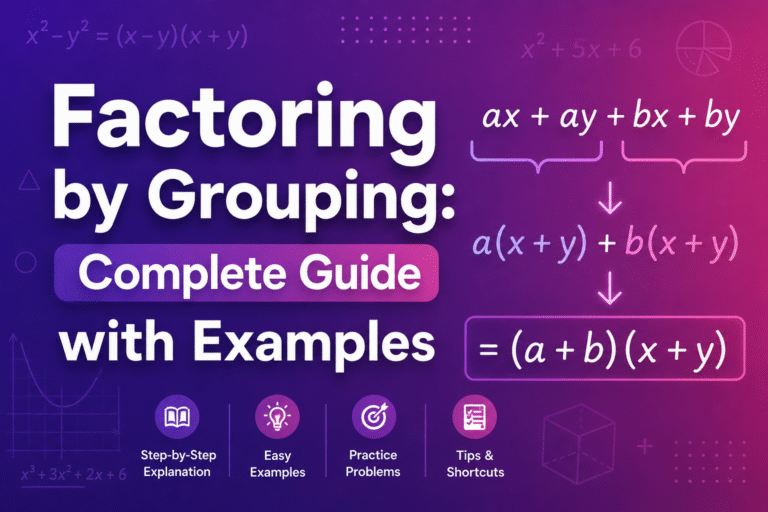
Step 2: factor 2x² + 7x + 3. Multiply a and c: 2 x 3 = 6. Find two numbers that multiply to 6 and add to 7: 1 and 6. Split the middle term: 2x² + x + 6x + 3. Factor by grouping: x(2x + 1) + 3(2x + 1) = (2x + 1)(x + 3). The full AC method walkthrough is on our AC method calculator page.
Step 3: (2x + 1)(x + 3) = 0. So 2x + 1 = 0, which gives x = -1/2, or x + 3 = 0, which gives x = -3.
Check x = -1/2: 2(1/4) + 7(-1/2) + 3 = 1/2 – 7/2 + 3 = 0. Correct.
Example 3: 3x² + 12x = 0 (factor out the GCF first)
Not every quadratic has three terms. Here both terms share a factor of 3x, and grabbing it first makes the problem trivial.
Step 1: 3x² + 12x = 0 is already set to zero.
Step 2: factor out the GCF: 3x(x + 4) = 0. Always look for a common factor before anything else; students who skip this step turn easy problems into hard ones.
Step 3: 3x = 0 gives x = 0, and x + 4 = 0 gives x = -4.
Notice that x = 0 is a perfectly valid solution. A factor of plain x just means zero is one of the roots.
When factoring does not work
Some quadratics refuse to factor over the integers. x² + 4x + 2 = 0 is one: no two whole numbers multiply to 2 and add to 4. That is not a dead end, it just means factoring is the wrong tool for that equation.
A quick test before you start: compute b² – 4ac (the discriminant). If it is a perfect square (1, 4, 9, 16, …), the quadratic factors neatly and this method is the fastest route. If it is not a perfect square, go straight to our quadratic formula calculator, which handles every case.
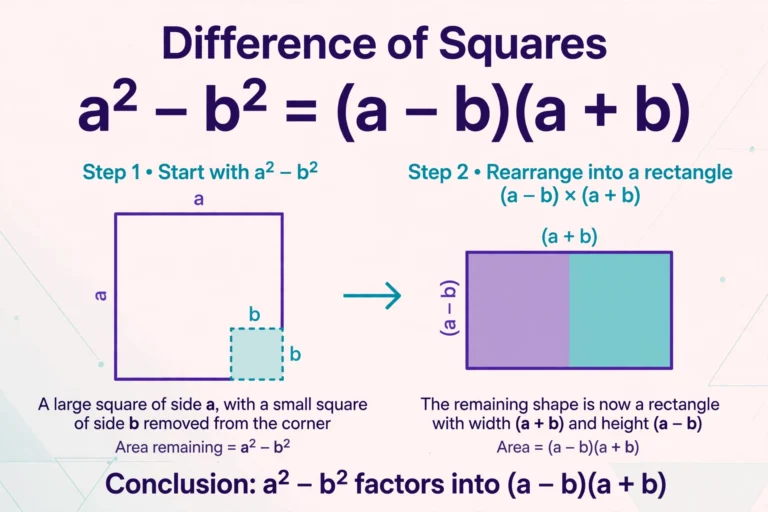
Two special patterns are worth recognizing on sight: x² – 9 = 0 is a difference of squares and factors as (x – 3)(x + 3) = 0, giving x = 3 or x = -3. And x² + 4x + 4 = 0 is a perfect square trinomial, (x + 2)² = 0, which has the single repeated solution x = -2.
5 mistakes that cost students the most marks
1. Forgetting to set the equation to zero first. Factoring x² + 5x + 6 out of x² + 5x = -6 without moving the -6 over is the single most common error. The zero product property only works when the product equals zero.
2. Setting each TERM to zero instead of each factor. In (x + 2)(x + 3) = 0 you set (x + 2) and (x + 3) to zero, not x, 2, x, and 3 individually. Factors are the things being multiplied.
3. Skipping the GCF. In 2x² + 8x + 6 = 0, factor out the 2 first to get 2(x² + 4x + 3) = 0. The numbers inside are smaller and the factoring is easier. (The 2 itself never gives a solution since 2 = 0 is impossible.)
4. Sign errors in step 3. From x – 5 = 0 you get x = 5, not x = -5. Slow down on the last tiny step; it is where most lost marks live.
5. Stopping after finding one solution. A quadratic has up to two solutions. If you found x = -2, keep going and find the second one. Always verify both in the original equation.
Practice problems
Solve each by factoring, then check your answers below.
- x² – 7x + 12 = 0 (Answer: x = 3 or x = 4)
- x² + 2x – 15 = 0 (Answer: x = -5 or x = 3)
- 2x² – 5x – 3 = 0 (Answer: x = -1/2 or x = 3)
- x² – 9 = 0 (Answer: x = 3 or x = -3)
- 4x² + 8x = 0 (Answer: x = 0 or x = -2)
Frequently asked questions
Do I always have to set the equation to zero before factoring?
Yes. The zero product property is the engine of the whole method, and it only applies when a product equals zero. Move everything to one side first, every time.
What if the quadratic does not factor?
Then factoring is the wrong tool for that equation. Use the quadratic formula instead; it works on every quadratic. Our quadratic formula calculator shows the steps.
Can a quadratic have just one solution?
Yes. A perfect square trinomial like x² + 4x + 4 = 0 factors as (x + 2)² = 0, so both factors give x = -2. It is called a repeated (or double) root.
How do I know whether to use factoring or the quadratic formula?
Check the discriminant, b² – 4ac. A perfect square means factoring will be quick and clean. Anything else, use the formula. With practice you will spot factorable quadratics on sight.
Why do I get the wrong answer when I factor correctly?
Most often it is a sign slip in the final step (x – 5 = 0 means x = 5) or a forgotten GCF at the start. Plug your answers back into the original equation; a wrong answer fails the check immediately.
Related factoring tools
- Factoring Calculator – factor any polynomial with steps
- Simple Trinomial Calculator (a = 1) – the product-sum method, worked out
- General Trinomial Calculator (a is not 1) – the AC method, worked out
- Quadratic Formula Calculator – for quadratics that do not factor
- How to Solve a Quadratic Equation on a Calculator – using a calculator for the same problems
Solving quadratics by factoring is three steps: set the equation to zero, factor completely, set each factor to zero. Learn the zero product property, keep the GCF habit, know when to reach for the quadratic formula instead, and check every answer in the original equation. Most school quadratics are built to factor, so this method will be your fastest route through them.