Rational Equation Calculator: Solve Rational Equations With Steps
Quick Answer: A rational equation is an equation with a variable in its denominator. To solve it, note the values that make any denominator zero and find the least common denominator. Then multiply both sides by it, solve the equation you get, and check each answer in the original equation. Drop any value that makes a denominator zero.
What Is a Rational Equation?
A rational equation is an equation that has at least one rational expression in it. A rational expression is a fraction where the top, the bottom, or both hold a variable. Here are two cases:
- 1/x + 1/2 = 3/4. This is a rational equation, since x sits in a denominator.
- x/3 + 2 = 5. This is not one, since the denominator 3 is just a number.
The key point is the variable in the denominator. That is what makes the equation rational, and it is also what makes checking your answers so vital. A value that turns a denominator into zero can never be a true answer. Division by zero has no meaning.
You meet rational equations in algebra class, in rate problems, and in work problems where two people share one job. The method stays the same in each case: clear the fractions, solve, then check.
How to Solve a Rational Equation Step by Step
Work through these five steps in order:
- Note the excluded values. Set each denominator equal to zero and solve. Those values can never be answers.
- Find the LCD. The least common denominator is the smallest expression that each denominator divides into. If you need a refresher, see our LCM calculator page.
- Multiply both sides by the LCD. This clears the fractions and leaves a plain equation.
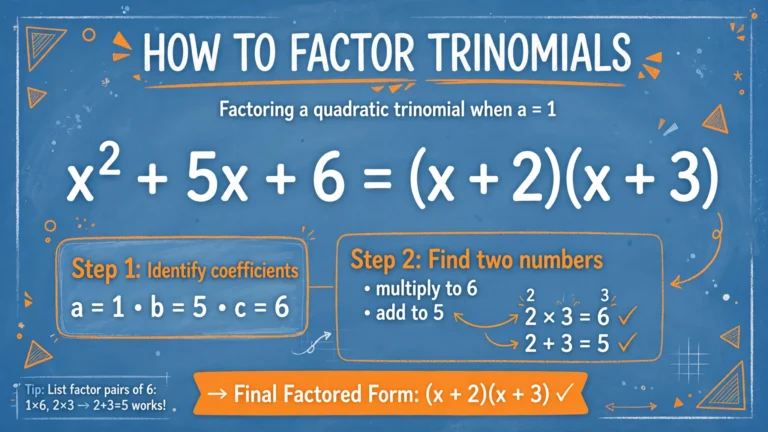
- Solve the plain equation. Use factoring or the quadratic formula if a squared term shows up.
- Check each answer. Put each value back into the original equation. Drop any value that makes a denominator zero. Such a value is called an extraneous solution.
Worked Example 1: A Simple Rational Equation
Solve x/(x + 1) = 2/3.
First, the excluded value: x + 1 = 0 gives x = -1, so -1 can never be an answer. Next, cross multiply, since each side is a single fraction: 3x = 2(x + 1). That gives 3x = 2x + 2, so x = 2. Check it: 2/(2 + 1) = 2/3, and the right side is 2/3. The answer is x = 2.
Worked Example 2: Fractions on Both Sides
Solve 3/x + 1/2 = 5/6.
The denominators are x, 2, and 6. The excluded value is x = 0. The LCD is 6x. Multiply each term by 6x: 18 + 3x = 5x. That gives 18 = 2x, so x = 9. Check it: 3/9 + 1/2 = 1/3 + 1/2 = 5/6. The answer is x = 9.
Worked Example 3: An Extraneous Solution
Solve (x + 1)/(x – 2) = 3/(x – 2).
The excluded value is x = 2, since it makes the denominator zero. Multiply both sides by (x – 2): x + 1 = 3, so x = 2. But x = 2 is the excluded value. Put it back in: both denominators become zero, so the fractions have no meaning. This equation has no solution. The value x = 2 is an extraneous solution, and it must be dropped.
When Solving Gives a Quadratic
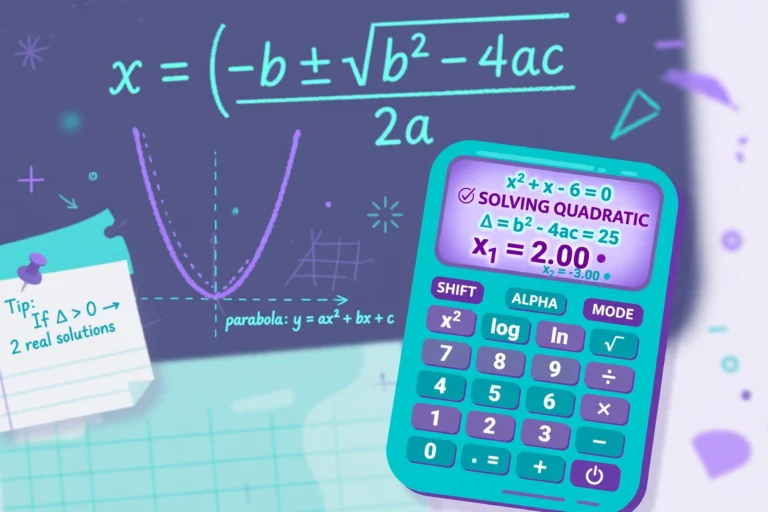
At times, clearing the fractions leaves a squared term. Then you get a quadratic equation. Factor it if you can. Our factoring by grouping page can help with hard cases. If factoring fails, use the quadratic formula. Then check each root the same way as before. A root that makes a denominator zero is extraneous, even if the algebra gave it to you.
Here is one such case. Solve 1/(x – 1) + 2/(x + 1) = 1. The excluded values are x = 1 and x = -1. The LCD is (x – 1)(x + 1), which is x² – 1. Multiply each term by it: (x + 1) + 2(x – 1) = x² – 1. That gives 3x – 1 = x² – 1, so x² – 3x = 0. Factor it: x(x – 3) = 0, so x = 0 or x = 3. Check x = 0: 1/(-1) + 2/1 = -1 + 2 = 1. Check x = 3: 1/2 + 2/4 = 1/2 + 1/2 = 1. Both roots work, and neither is an excluded value. The answers are x = 0 and x = 3.
Rational Equations vs Rational Expressions
These two terms sound alike, yet they ask for distinct jobs. A rational expression is just a fraction with a variable in it, like (x + 2)/(x – 1). You can simplify it, but you cannot “solve” it, since it has no equals sign. A rational equation has an equals sign, like (x + 2)/(x – 1) = 3. Your job there is to find the values of x that make the two sides match. If you mix these two up, you may try to solve a thing that has no answer. You may also simplify a thing that needs solving. If your task is to simplify fractions with variables, see our rational expressions calculator guide first.
Common Mistakes to Avoid
- Skipping the check. This is the top mistake. An unchecked answer may be extraneous.
- Multiplying by zero. Never multiply both sides by an expression that could be zero without noting the excluded values first.
- Dropping a term. When you multiply by the LCD, multiply each term, not just the fractions.
- Sign slips. Take care with minus signs when you clear brackets after multiplying.
Practice Problems
Try these, then check your answers:
- Solve 2/(x + 3) = 1/2. (Answer: x = 1. Check: 2/4 = 1/2.)
- Solve 1/x + 2/3 = 5/6. (Answer: x = 6. Check: 1/6 + 4/6 = 5/6.)
- Solve x/(x + 1) + 2/(x + 1) = 3. (Answer: x = -0.5. Check: (-0.5)/(0.5) + 2/(0.5) = -1 + 4 = 3.)
Frequently Asked Questions
What is a rational equation?
It is an equation with at least one fraction that holds a variable in its denominator. 1/x = 2 is one. x/2 = 4 is not one, since its denominator is just a number.
How do you solve a rational equation?
Note the excluded values and find the LCD. Multiply both sides by it, solve the plain equation, then check each answer in the original equation.
Why do extraneous solutions appear?
Multiplying both sides by an expression with a variable can add values that were not answers to start with. The check step catches them.
Can a rational equation have no solution?
Yes. If each value you find turns out to be an excluded value, the equation has no solution. Worked Example 3 shows this case.
What is the LCD of a rational equation?
It is the least common denominator: the smallest expression that all the denominators divide into. Multiplying by it clears all the fractions at once.
For more work with fractions that hold variables, see our rational expressions calculator guide. For plain factoring help, start with how to factor polynomials.